

Organic Chemistry Quizzes Launch

Posted on November 5th, 2012

We are pleased to announce that Quiz Mode has officially launched and is now available for use. There is no need to download an update, all upgrades have been automatically incorporated into every account.

In addition to the launch of this new mode, a new Account Homepage has been created, in addition to other esthetic and functional upgrades throughout the site.
Here are some highlights:
1) Study Mode and Quiz Mode
We have now completed our transition to an overall method of having two main reaction flashcard modes: Study Mode and Quiz Mode.
Study Mode:
The original StudyOrgo.com flashcard system will now be known as Study Mode. It will remain as is with some tweaks including one major difference. All reaction flashcards windows will now be revealed at baseline to facilitate learning of all the information on the flashcard without having to reveal each area of the card. However, should you want to use Study Mode in its original manner, you may click on the “Study Flashcards Covered” checkbox found on any flashcard page to restore the system to its original fashion.
Quiz Mode:
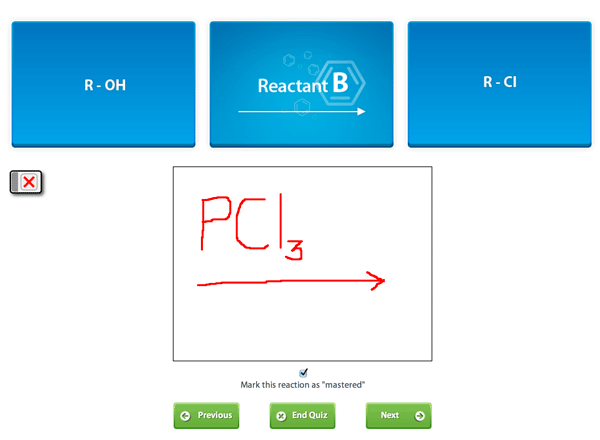
You now have the ability to construct custom quizzes to test your knowledge of the material learned in Study Mode in our new Quiz Mode. You have options of choosing specific reaction categories, number of questions and the part of the reaction that you would like to be quizzed on among other items. Use the drawing space below the reaction to draw your response. When ready, click on the covered window to reveal the answer. Compare your response to the correct answer. Once you have mastered a particular reaction, you may mark it as “mastered” by checking the box found underneath the reaction. When you end a particular quiz, review your performace using our review page. The marked as mastered feature is maintained between the two modes. You can even exit and save quizzes and continue working later.
2) Account Homepage

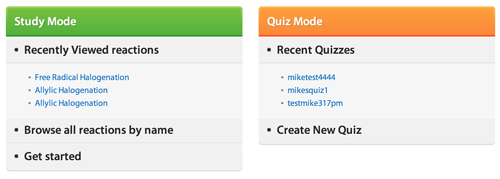
Your new account homepage organizes the main features of the Study Mode and Quiz Mode into one neat dashboard.
  • Under the Study Mode section you can take advantage of helpful shortcuts such as recently viewed reactions, browse all reactions by name and review all reaction flashcards.
  • Under the Quiz Mode section you can jump to recent quizzes or create a new quiz.
  • There are also shortcuts to our additional materials such as the Summary Guide and Exercise Sets, Study Charts, and Reaction Roadmap.
Feel free to log in and browse the changes and take advantage of our new and improved program.

Chirality, Stereoisomers, Enantiomers

Posted on October 12th, 2012

Hello Orgo Students!

Here at StudyOrgo.com we like to simplify things. You know that whole big chapter in your textbook on Chirality, Stereoisomers and Enantiomers that’s so confusing that you’re just lost?! Well, let’s see if we can simplify things.

Here is our summary on the topic:

This is some of the information presented in Part 9 of our Study Guide: one of the many resources available to StudyOrgo.com members. Learn more about it here: http://www.studyorgo.com/how-it-works.php


  1. Chiral
    1. Definition: a plane of symmetry does NOT exist in a given structure
    2. Two objects are chiral if they are NOT superimposable on one another
  2. Achiral
    1. Definition: a plane of symmetry DOES exitst in a given structure
    2. Two objects are achiral if they are superimposable on one another
  3. Enantiomers
    1. Definition: Two isomers that are mirror images of one another
    2. Enantiomers are chiral and they are NOT superimposable on one another
    3. Properties of Enantiomers
      1. A pair of enantiomers almost have identical properties. They differ in one aspect:
        1. Two enantiomers rotate plane-polarized light in opposite directions
          1. Plane polarized light are light waves that travel only in one plane
          2. This is referred to as optical activity
          3. Clockwise rotations are abbreviated by a (+) or the letter “d”
          4. Counterclockwise rotations are abbreviated by a (-) or the letter “l”
    4. Racemic mixture
      1. Definition: When equal amounts of each enantiomer of a pair are mixed together
      2. While each individual enantiomer on its own is optically active, when the two equal amounts are mixed together, the mixture is NOT optically active
    5. Meso compound
      1. Definition: A structure that possesses both a plane of symmetry and at least one asymmetric carbon. Meso compounds are achiral.
    6. Chiral carbons
      1. A chiral carbon has four different items attached to it.
      2. A chiral carbon is also known as asymmetric carbon
      3. The chiral carbon is the chirality center of the molecule
      4. Enantiomers possess chiral carbons.
  4. R and S nomenclature
    1. Used to assign an identifying label to each chiral carbon in a given enantiomer
    2. How to determine R and S nomenclature
      1. Step 1: Find the chiral carbon
      2. Step 2: Assign the numbers 1 through 4 to each item attached to that carbon.
        1. Assign 1 to the item that is of highest priority through 4 to the item of lowest priority
        2. Hierarchy of priority (in order from most important to least important)
          1. a. Halogens (I>Br>Cl>F)
          2. O
          3. N
          4. C
          5. H
        3. Some important notes:
          1. a. Often you will have a tie. In that case, go to the next item after that atom to break the tie and determine the priority.
          2. b. When encountering double or triple bonds, pretend they are single bonds and duplicate the items attached to that bond. Duplicate twice for triple bonds.
      3. Step 3: Draw a circle from 1 to 2 to 3 to 4.
        1. Before starting, look and see where item #4 is. If item #4 is within the plane of the screen or paper: redraw the image to have item #4 going into the plane of the screen or paper before continuing.
          1. If item #4 is going into the screen or paper or coming out of the screen or paper, continue as follows.
        2. Determine if the circle was drawn clockwise or counterclockwise.
        3. If the circle was drawn clockwise: assign the letter “R”
        4. If the circle was drawn counterclockwise: assign the letter “S”
      4. Step 4: Check and see where the item #4 is
        1. Usually this item is a hydrogen. If item #4 is in the plane positioned behind you or is going into the plane of the screen or paper then leave the assigned letter as is. However, if item #4 is positioned in front or is coming out of the plane of the screen or paper, then assign the opposite letter from what you assigned in Step 3.
        2. If item #4 is coming out of the plane of the screen or paper? assign the opposite letter
          1. If R was chosen: new assignment is S
          2. If S was chosen: new assignment is R
        3. Remember, if item #4 is within the plane of the screen or paper: redraw the image to have item #4 going into the plane of the screen or paper before determining clockwise or counterclockwise (see step 3 above).

Q & A: Organometalics and Grignard Reagents

Posted on September 30th, 2012

Question from one of our users:

Does your program cover organometalics?

Answer:

Yes, organometalics, specifically grignard reagents, are certainly covered in our program. They are predominantly covered over three reactions in the Alcohols category. There is also an example of Grignard epoxide opening in our alkenes section.

Here is where they are covered:
Alcohols:
Alcohol Formation (reaction 1 of 25)
Grignard Epoxide Opening (reaction 19 of 25)
Grignard Formation (reaction 20 of 25)

Alkenes:
Epoxide Opening (reaction 14 of 25)

 
Happy studying!

Acid-Base Organic Chemistry

Posted on September 21st, 2012

The acid-base properties of organic compounds are of utmost importance as they can provide critical information regarding the reactivity of a given compound.

Organic compounds can be defined in a number of different ways:

Acid Base
Arrhenius Dissociation in water yields H+ Dissociation in water yieldsOH
Bronstead-Lowry Proton (H+) donor Proton (H+) acceptor
Lewis Electrophile (a compound that accepts electrons) Nucleophile (a compound that donates electrons)


After determining whether the compound is an acid as opposed to a base, one can look at the pKa to determine its strength. The lower the pKa, the stronger the acid. Also, the more readily a compound can donate a proton, the more acidic it is. Certain functional groups are more acidic than others (such as carboxylic acids and phenols). The more stable a molecule is without a proton, the more easily it will give it up and become deprotanated. On the other hand, the more readily a compound donates electrons the more basic it is. These acid-base properties all play an important role in the reactivity of organic compounds.

For more information regarding Acid-Base Organic Chemistry- check out Part Seven of the StudyOrgo.com Summary Guide. To practice what you learned, test your knowledge with the Part Seven Exercise Set.

Hybridization and Molecular Orbitals Help!

Posted on September 10th, 2012

Confused about hybridization or molecular orbitals? Don’t be! The details can be very confusing, but don’t loose site of the overall big picture!

Many exams in organic chemistry courses and on standardized exams focus on a number of key concepts and actually don’t typically require that you completely understand the nuts and bolts of the topic.

For example, a very common exam question is regarding the sigma bonds (σ) and pi bonds (π) in molecules. Here we sum it up for you. If you are looking for some practice then sign-up at StudyOrgo.com and  check out our Molecular Orbitals, Hybridization and Geometry Exercise Set!

    1. Molecular orbital =overlap of two atomic orbitals from different atoms
    2. There are two types of bonds formed in molecular orbitals: sigma bonds and pi bonds.
    3. sigma bond (σ)= overlap of hybridized orbitals along the line between nuclei
      1. single bonds are sigma bonds
      2. double and triple bonds each have one sigma bond
    4. pi bond (π)= sideways overlap between two p orbitals
      1. double bonds have one pi bond
      2. triple bonds have two pi bonds
      3. there must be a sigma bond in order for a pi bond to occur
    5. Summary Chart
Bond Sigma bonds Pi bonds Total
Single 1 0 1
Double 1 1 2
Triple 1 2 3