Archive for the "Organic Chemistry General" Category

The Science of Nasal Anatomy: Structure, Function, and Facial Balance

Posted on April 12th, 2026

In addition to organic chemistry, understanding human anatomy helps connect scientific principles to real-world biological function. The human body is a complex system where structure and function are closely linked, and one of the most interesting examples of this relationship is the nose.

The structure of the nose plays a key role in both breathing and appearance, which is why procedures like nose reshaping surgery are sometimes used to improve function and balance.

While often associated with appearance, the nose plays a vital role in respiratory health, air filtration, and overall facial balance. Studying nasal anatomy provides insight into how even small structural variations can impact both function and symmetry.

The Structure of the Nose

The nose is composed of both bone and cartilage, forming a framework that supports its shape and function. The upper portion consists primarily of nasal bones, while the lower portion is made up of flexible cartilage that allows for movement and structural variation.

Inside the nose, the nasal septum divides the cavity into two passages. This structure plays a key role in directing airflow. When the septum is straight, air can move efficiently through both sides. However, when it is deviated or irregular, it can restrict airflow and lead to breathing challenges.

Function: More Than Just Breathing

As air enters the nasal passages, it undergoes several important processes. The nose filters out dust, allergens, and other particles, while also humidifying and warming the air before it reaches the lungs. This helps protect the respiratory system and maintain optimal function.

Specialized structures within the nose, such as the turbinates, increase surface area and improve the efficiency of this process. These features demonstrate how anatomical design directly supports physiological function.

Nasal Anatomy and Facial Balance

Beyond its functional role, the nose is a central feature of the face and significantly influences overall appearance. Its size, shape, and projection affect how other facial features—such as the chin, jawline, and forehead—are perceived in relation to one another.

In studies of facial proportions, balance and symmetry are often linked to how well these features align. Even subtle changes in nasal structure can alter the visual harmony of the face, which is why the nose is often a focal point in both scientific and medical discussions of facial anatomy.

When Structure and Function Intersect

In some cases, individuals may experience structural concerns that affect both breathing and appearance. These may result from natural development, injury, or anatomical irregularities such as a deviated septum.

When these issues extend beyond what can be addressed through non-invasive methods, medical procedures such as rhinoplasty may be considered. From a scientific perspective, this procedure focuses on modifying nasal structure to improve airflow, restore balance, and support both functional and aesthetic outcomes when performed by a qualified specialist.

The Importance of Studying Anatomy

Exploring topics like nasal anatomy highlights the importance of understanding how different systems in the body are interconnected. It reinforces the idea that form and function are not separate concepts, but rather deeply integrated components of human biology.

For students studying science, medicine, or health-related fields, this serves as a practical example of how theoretical knowledge can be applied to real-world scenarios. By understanding structure at both the macro and micro levels, we gain a deeper appreciation for how the body operates as a whole.

Conclusion

The nose is far more than a defining facial feature—it is a sophisticated structure that plays a critical role in both physiology and appearance. Through the study of anatomy, we can better understand how structural variations influence function, and how science continues to inform advancements in medical and surgical techniques.

Alkylide Anions: Making new C-C bonds with Alkynes

Posted on April 16th, 2019


Many students taking Orgo 2 have commented there are a few types of reactions the professors save to the end of the semester and cover quickly and “gloss” over or sometimes skip all together in the interest of time.  However, you will be responsible for all of the reactions necessary for multi-step synthesis (starting product known to get to unknown final product) and retrosynthesis (product known to get to unknown starting material) reactions.  We at StudyOrgo don’t want you to get stuck on trying to cram for exams by studying reactions that were poorly covered in your class.  In this article, we focus on how to make new C-C bonds using alkenes.

Alkynide Anion Formation

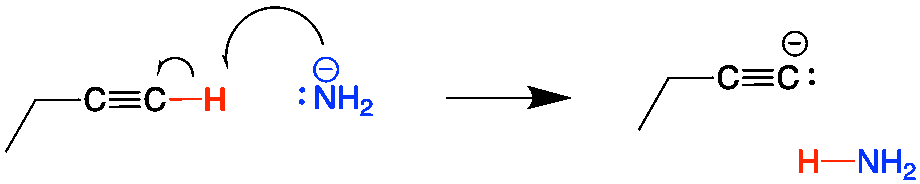
First, the terminal alkyne must be deprotonated with a strong base, such as sodium amide (NaNH2).  This proton can be removed because terminal alkyne hydrogens are more “acidic” than alkene or alkane hydrogens.  This forms the alkynide anion, which is a great nuleophile.

Next, the a alkynide anion must attack a primary or secondary carbon center to perform an Sn2 type reaction. This displaces the leaving group and forms the new C-C triple bond, which has now become an internal alkyne.

Once you have the the new alkyne, you can choose to reduce the alkyne to an alkene or alkane, or you can transform the alkyne into many other functional groups, including a ketone  or an alcohol by hydration.

Remember, alkynes are a great tool to build large carbon skeletons using simple haloalkanes.  Remember this reagent for the exam!  We here at StudyOrgo have devoted countless hours to preparing complex reaction mechanisms in simple and easy-to-understand manner to help you maximize your studying.  Sign up with StudyOrgo for detailed explanations of epoxide reaction mechanisms and other essential Orgo 2 reactions today!


Huckel Aromaticity and Frost Circles

Posted on January 29th, 2019


As Orgo 2 lectures start up, there will be a number of concepts that will be covered quickly to speed up the class so you can learn lots of functional group transformations this semester. In this article, we will discuss the concepts and theories of Thermodynamics.  While the topic sounds complicated, we at StudyOrgo have extensive experience instructing principles and reaction mechanisms frequently covered in Organic Chemistry. Sign up today for clear, detailed explanations of over 180 Orgo Chem reactions and reviews on conceptual topics!


Aromatic compounds contain conjugated systems of pi bonds, meaning one pi bond after another, that are arranged in a ring.  This creates a current of electron density that circles the compound. If the pi electrons fill the bonding molecular orbitals, the compound becomes aromatic!  But if too many pi electrons are present, the non-bonding and antibonding orbitals become occupied, and the compound is now anti-aromatic.


Aromatic compounds are UNUSUALLY STABLE and have important chemical and synthetic uses.  How do we know if the compound is aromatic or not?


Here is a short list of rules lists the properties of aromatic compounds.
The Huckel aromaticity rules are:

  1. Molecule is cyclic
  2. Have one pi orbital per atom of the ring
  3. Planar, in an SP2 hybridized orbital, over every atom of the ring
  4. Have a closed loop of 4n+2 pi-bond electrons, where n is equal to any integer (0,1,2,3,…)


However, anti-aromatic compounds have an unusual INSTABILITY to them.
The Huckel anti-aromaticity rules are:

  1. Molecule is cyclic
  2. Have one p orbial per atom of the ring
  3. Be planar, in an sp2 hybridized orbital, over every atom of the ring
  4. But, anti-aromatic compounds have a closed loop of 4n pi-bond electrons.


Many times students are asked to describe the molecular orbitals of aromatic compound examples.  How do we know what they look like?  An easy way to describe the molecular orbitals of small conjugated rings is to draw a Frost Circle.  To do this, follow the steps below.

  1. Draw a circle
  2. Connect the carbon atoms to the circle such that one is always pointed at the bottom
  3. Draw a horizontal line at each carbon – this represents the pi bond molecular orbitals
  4. Draw a dotted line through the middle of the circle – this is the boundary between bonding and antibonding orbitals.
    1. Anything pi electrons occupying an orbital below the line are in a bonding orbital and are STABLE
    2. Any pi electrons on the line or above the line are in non-bonding & anti-bonding orbital and are UNSTABLE.

Below are the Frost Circles for many types of rings.

Before you begin, make sure the Huckel rules apply; do you have enough electrons? Is it SP2 hybridized?  Is it a ring? Is it planar?  Some aromatic rings are heterocyclic (elements other than carbon) and ionic (meaning one of the elements in the ring has a charge).  If you have the Huckel rules applied, then determine the number of pi electrons and fill in the Frost Circle.

Here is butane.

Three double bonds = 6 pi electrons.  Paired together, all of the pi electrons are in bonding orbitals so benzene is in fact aromatic.


Here is cyclooctatetraene.

Four double bonds = 8 pi elecrons, Pairing the first 6 electrons in the bonding orbitals, we place last 2 electrons in each of the non-bonding orbitals.  Because of these two electrons, this molecule is anti-aromatic!


Practice, practice, practice!  This is our suggestion to learn these tricks.  As you advance to aromatic reactions, it will be much easier to find shortcuts to faster synthesis schemes and solve more complicated examples which will surely be on your final exam.  Sign up with StudyOrgo.com today to master over 180 organic chemistry reactions and learn the mechanisms fast!


Study Ahead for Proton NMR

Posted on December 22nd, 2018

Reading the 1H-NMR Spectra

One of the most practical techniques covered for organic chemistry is the method for determining the chemical structure of unknown compounds. In this article, we will summarize the concept of proton NMR, the most informative NMR spectroscopy utilized by organic chemistry students.

During the second semester of organic chemistry, many professors will ask you to read 1H-NMR spectrum as a question or ask you to use the answer in other parts of the exam, which makes getting the correct structure a major obstacle in getting a great grade on the exam!

Why use proton NMR at all?  The answer is abundance. Virtually all organic chemistry molecules contain hydrogen, and since the NMR active isotope is 1H, which has a 99.98% abundance on Earth, it makes it a convenient and easily detected atom. An unknown sample in a strong magnetic field allow 1H nuclei to “resonate”, which means their nuclear spins flip at a unique electromagnetic (EM) frequency (Hertz, Hz).  The frequency at which the nuclear spin flips depends on the “chemical environment” the nucleus is in, meaning what other functional groups are in close proximity to the hydrogen atom.

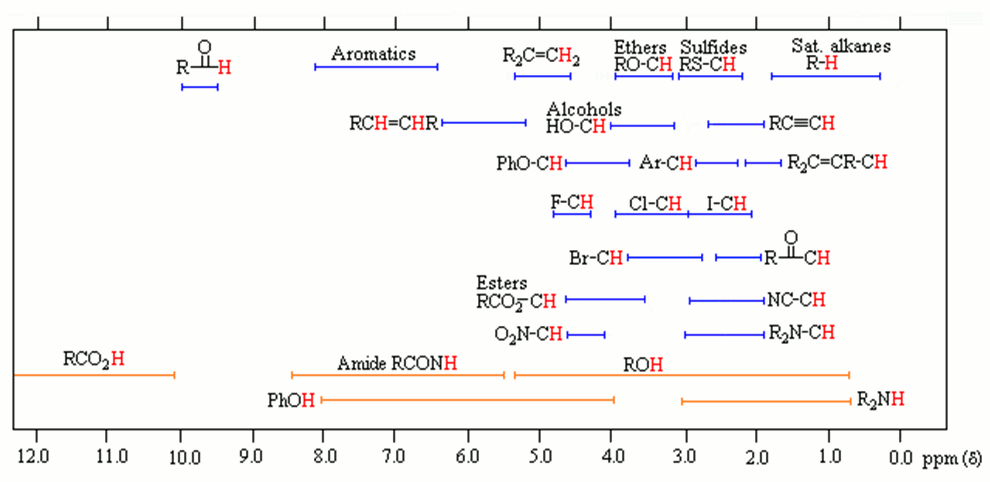
The NMR instrument detects this and plots it on a graph in units of ppm.  This value is relative to an internal standard, tetramethylsilane (TMS) which is arbitrarily set at 0 ppm. The signals originating from your unknown sample are recorded as a net difference from the TMS reference.  The ranges for common functional groups are shown in the graph below.

Notice that protons (in red) neighboring or attached to electronegative elements (N,O,S,Cl,Br,I) have a large chemical shift (d).  This is referred to as “downfield” on the spectrograph. This is due to the deshielding effect, which is simply that the electron cloud around protons near electronegative or electron-withdrawing groups are smaller, so less EM radiation is required to resonate the nucleus.  Conversely, when the proton is surrounded by hydrocarbons, the chemical shift is <2 ppm.  This is because these proton nuclei are “shielded” from the magnetic field and higher energy is required for them to resonate and referred to as “upfield” on the spectrograph.  Once a NMR spectrograph is recorded, 4 pieces of information can be determined from the data as long as the chemical formula of the compound is known.

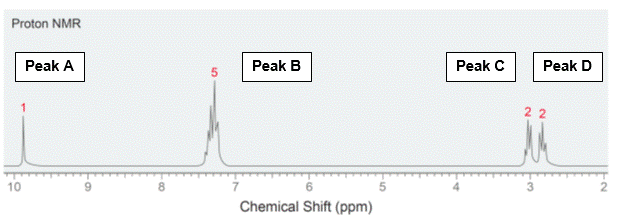
To illustrate the points, we will consider the following 1H-NMR spectrum of the C9H10O.

  1. Signal Count – Number of unique hydrogens

This is the easiest to interpret.  The number of peaks correspond to the number of unique, or chemically indistinguishable, hydrogen nuclei.  There are 4 peaks on the graph, therefore of the 10 hydrogens in the molecule, there are 4 types of protons.

  1. Chemical Shift – Identity of neighbors

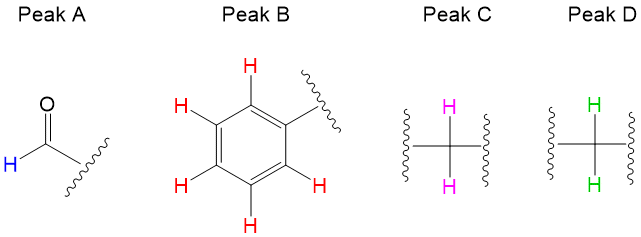
This information refers to the chart shown above. Peaks C & D on the spectrum are located at (d)3.1 and (d)2.7, likely indicating C-H bonds near some electron-withdrawing groups. Further downfield on the graph, peak B is at 7.4, likely indicating an aromatic group and peak A at 9.9, likely indicating a proton of an aldehyde, which accounts for the one oxygen atom in the formula.  From this information, we now know there is an aromatic ring (6 carbons) and an aldehyde (1 carbon).  That leaves 2 carbons left, and since two types of C-H bonds from peaks C and D information, therefore we have accounted for all carbons and hydrogens, now we have to put them together.

  1. Integration – Number of Equivalent Hydrogens

Integration is the calculation of the area beneath the peaks.  This information is determined by the computer software and would not be required for you to determine from visual inspection.  But if it is provided, it will instantly determine the number of “equivalent” (or chemically indistinguishable) hydrogens in your graph.  Looking at our spectra, Peak A = 1 which would make sense for an aldehyde proton.  Peak B = 5, meaning an aromatic group with 5 hydrogens, that means only one substituent can be attached to the ring.  This is an important piece of information since we could think of many types of rings. Peak C = 2 and Peak D = 2, this is also helpful since we now know both carbons are internal, meaning they are not at the ends of the molecule (we would need 3 hydrogens to be a methyl at the end of the molecule).  With this information, you could likely predict the structure.

Signal Splitting – Number of Non-equivalent Hydrogen Neighbors

Signal splitting occurs from a phenomenon of coupling, which occurs when NON-equivalent neighboring protons interfere with the resonance of a proton nuclei.

Rule #1: starting from the hydrogen, count three nuclei away.  If you do not land on another proton, then there is no splitting contribution to the proton’s environment.

Rule #2: the degree of splitting occurs in an N+1 rule.  For instance, Peak A has a singlet, meaning 0+1. This indicates that there are NO protons neighboring the aldehyde. Peak B is a multiplet, and is indicative of an aromatic group given 5 hydrogens present.  Peak C and D are both triplets, meaning 2+1. This means each type of proton has two non-equivalent neighbors.  Thus, peak B and C are next to each other.

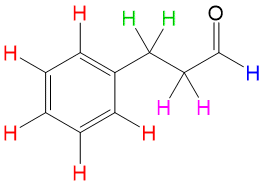
With all of this information, the only chemical structure from the spectrum that would make sense must be 3-phenylpropanal, shown above.  This is an example of the clear-cut explanations you will receive with your membership with StudyOrgo. With practice and help from StudyOrgo, you’ll be solving your organic reaction problems in no time!

Want to try it about before you purchase? No problem- check out our sample reaction flashcard page.

Ready to sign up? Sign up here.


How to Approach Multi-Step Synthesis Questions

Posted on November 1st, 2018


Professors often begin to expect students to perform synthesis (reactant to product) or retrosynthesis (product back to available reactants) on the exam.  This can be one of the most intimidating exercises because the products and reactant can look so different from each other it would seem at first glance its not possible to figure it out.  But here at StudyOrgo, we work to bring you clear explanations and clear-cut explanations to tackle many organic chemistry reactions and synthesis questions you will see in Orgo1 and Orgo2.


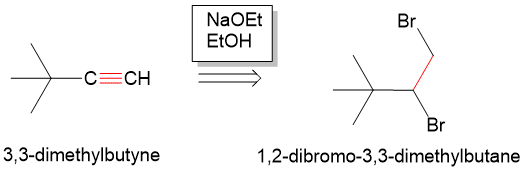
Let’s take a look at the retrosynthesis of 3,3-dimethylbutyne from 3,3 dmethylbutanol.  At first you may see the reagent has an alcohol group but maybe you wonder “how am I going to get to an alkyne, we haven’t even seen alkynes yet!”

The first step is to see which bonds have changed between the products and reactants and we can see the bond colored in red.  Since only one bond changed, this is relatively “easy” example.

Starting from an alkyne, remember that each double bond represents the presence of a pi bond that can be formed from an elimination reaction.  So, think “what can we eliminate that would have resulted in pi bond formation?”  Remembering E2 reaction mechanisms, any neighboring anti-periplanar proton and Br (leaving group) can be eliminate with a strong base to form a new pi bond.  In the case of the alkyne, we would need two leaving groups and two rounds of elimination to form an alkyne.  Thus, if we form two Br bonds to each of the carbons, we can then form the alkyne from 1,2-dibromo-3,3dimethylbutane.  In the forward reaction, we can do this with a strong base such as sodium ethoxide (NaOEt) in ethanol to form the alkyne.

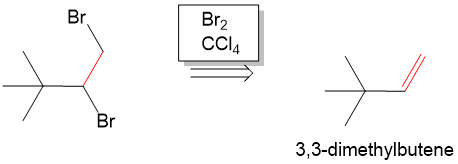
Next, we have to form the haloalkane.  To do this, we would have to carry out an addition reaction.  Seeing that we need a Br on each carbon, it is not too difficult to realize that if we added Br2 across an alkene, then we can then from the haloalkane from 3,3 dmethylbutene.  In the forward reaction , we can do this by reacting the alkene with Br2 in chloroform to form the haloalkane.

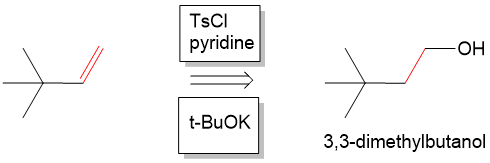
Next, we have to form the alkene.  At this point we are looking for a way to come back to the starting material, which is 3,3 dmethylbutanol.  We could think of forming an alkene from 3,3 dmethylbutanol by performing another E2 elimination (or dehydration) to remove the alcohol and anti-periplanar proton which would form 3,3-dimethylbutene. In the forward reaction, we can do this by activating the alcohol with tosyl chlroide to make a very good leaving group and then reacting with a strong base such as potassium tert-butoxide (t-BuOK) to form the alkene.


And there you have it!  A three step synthesis from the alkyne product from a starting alcohol using reactions that are typically covered in the first few weeks of class.  Practice is the only way to learn these tricks and the more reactions you know, the easier it will be to find shortcuts to faster synthesis schemes and solving more complicated examples which will surely be on your final exam.  Sign up with StudyOrgo.com today to master over 180 organic chemistry reactions and learn the mechanisms fast!