Archive for the "Organic Chemistry General" Category

Preparing to Study Organic Chemistry

Posted on August 28th, 2014

Many students find themselves lost by the end of semester in Organic Chemistry.  This has led to a terrifying perception of Organic Chemistry that is passed down from upperclassmen.  We at StudyOrgo are here to say, you can make it!  You just need the right strategy to succeed.

“Divide and Conquer”
247The best way to stay ahead of the semester is to divide your chapters into blocks that you will study.  Most professors will have a fairly clear outline of what chapters from your book will be covered before each exam.  Your goal here should be to divide your time (starting right now!) until the exam into blocks to study.  Some chapters, like substitution (e.g. SN2) and elimination (e.g. E2), are longer than others because these reactions are the foundations for future reactions you will learn later in the course.  So, spend a lot of time mastering these important topics.  Finished a chapter early?  Move ahead and don’t wait until you receive the lecture to start studying.  Many people find studying before the lecture help them to really understand what the professor is saying and will give you an opportunity to ask questions right away.

But remember; no one is a better judge of your understanding than you!  If any material is unclear, don’t move forward until you are confident and seek help immediately.  StudyOrgo.com has developed a customized presentation of difficult concepts in organic chemistry into an easy to understand format with a step-by-step breakdown and description of common reaction mechanisms in organic chemistry.

 Schedule your studying times

To achieve your “divide and conquer” plan, get serious about studying the material.  The best way to this is to schedule yourself an “appointment.”  Carry out your studying at a designated spot, we recommend not studying in the comfort of your home or dorm room where distractions are copious.  Pick a coffee shop, library or classroom to force yourself into studying.  Learning these time management skills will not only help you earn a passing grade in Orgo, it will help you in your career as well!

Practice Problems

Professors are notorious for advertising to their students that homework is not mandatory and/or you will be graded on the homework.  Relax then, right?  Wrong!  An important realization to make is that there are only so many types of questions a professor can ask.  Therefore, if you see a ton of practice problems, chances will be high you have already seen the exam problem. Many professors will throw in “really hard” questions that terrify students and it may seem like they are just being plain evil.  There is a reason for everything!  Professors use this tactic to assign A’s to the students who have kept up and followed along the whole time and rightfully so since these questions cannot be answered without understanding everything they have covered.  You can be one of the few who aces these questions!

Review Materials before the Exam

Either you have been following the steps above the whole semester and you are ready for that exam… or you read our article too late and the exam is next week.  There is still hope!  Simply adjust the “divide and conquer” strategy to fit the time you have remaining until the exam.  We suggest you review ALL of the material though and not just what you think you don’t know.  In our experience, the difficulties students have are often because they missed a concept earlier on.  Orgo is like a pyramid, the top falls without a strong base.  Here at StudyOrgo, we have developed easy to follow review study guides and exercise sets to help with reviewing all the concepts you will have to master to pass the course!  Check out www.studyorgo.com/summary.php for more details!
Free Radical Halogenation

Posted on February 21st, 2014

Hey Guys!

Want to learn Free Radical Halogenation but feel that your textbook is just too darn boring? Or maybe your more of a visual learner?

Check out our latest video on Free Radical Halogenation and stay tuned for more videos in our StudyOrgo.com Reaction Video Series.

Here you go!

Best,

Orgo Dan

What is the best site for learning organic chemistry?

Posted on January 5th, 2014

This is a very common question that comes up. These days, studying organic chemistry is transitioning from textbooks and paper flashcards to web-based materials. While going to class and reading your textbook is important, the use of additional online programs is becoming increasingly more popular. Paring a web-based preparatory program with your classroom instruction can really enhance your learning and understanding of the material and consequently yield a higher grade in the course and on important pre-professional standardized exams.

Here are some important characteristics to look for when choosing what online program to use:


  • User-friendly: Consider a program with high-end graphics and images, a polished interface with easy to use functions. This will help remove the time that is often wasted trying to learn how to use a program and allows the student to jump right in to studying.

Reactions

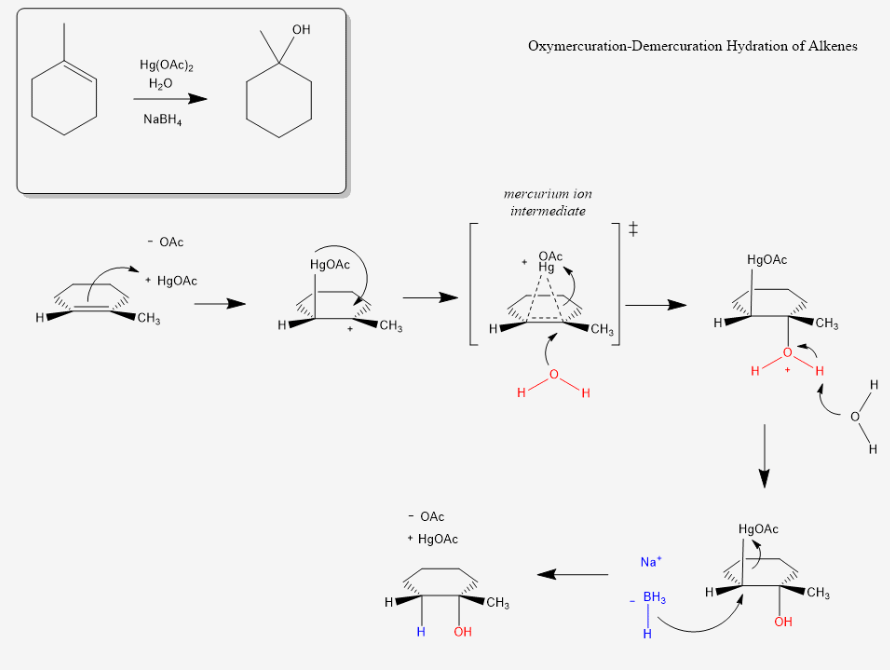
  • Comprehensiveness and completeness: You will want a program that has all the information you need and none of the stuff you don’t need to know. For example, when studying reactions, look for programs that include, a clear reaction name, reaction category, simplified reaction, important hints and notes and a well written, detailed, step-wise reaction mechanism.

Screen Shot 2014-01-05 at 12.17.01 PM

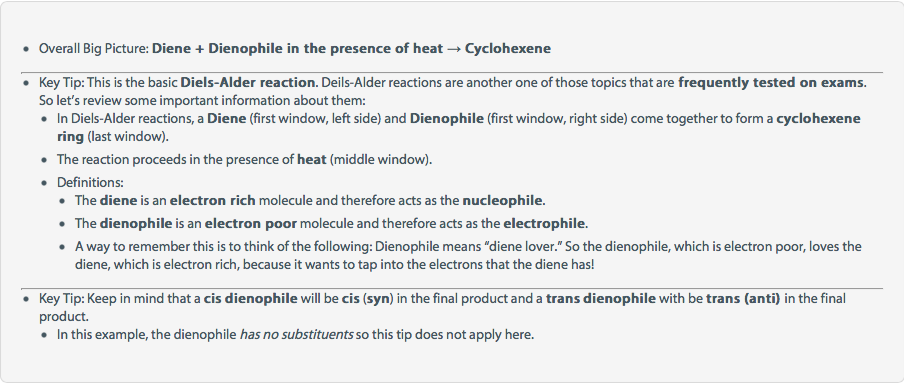
  • Use of helpful hints and tips:  Look for a program that will allow you to study the least information possible, in the shortest amount of time while still earning high grades. Most people taking organic chemistry are taking the course with a passion to enter a field, which tags organic chemistry as a requisite course, and are not planning on organic chemistry careers. Therefore be sure to use a study program that is written that way. In essence choose a program that offers “high-yield information.” This means that the site provides all of the necessary facts and notes on each reaction while revealing all of the frequently tested key points that are favorites among university classroom exams and standardized exams alike.

Screen Shot 2014-01-05 at 11.54.45 AM

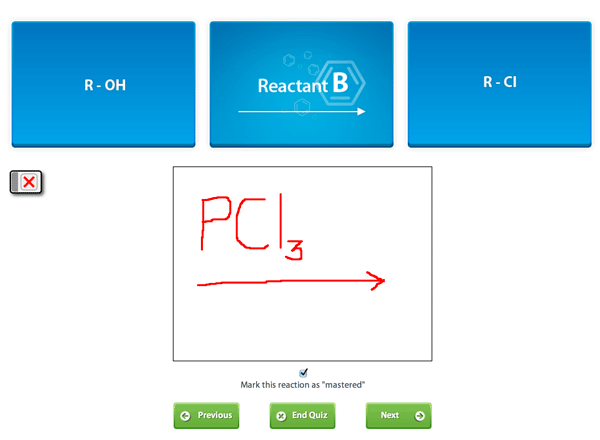
  • Practice makes perfect! Look for a program that offers a high-customizable quiz function where you can create your own quizzes to test your knowledge. Many programs offer cookie-cutter pre made quizzes and flashcards that don’t apply to what you are learning! Choose a program that lends you the ability to have a say in practicing what you are learning.

quiz

All of these characteristics are deeply embedded into the fabric that is StudyOrgo.com

StudyOrgo.com is the ideal online Organic Chemsitry learning program and can take you by the hand to teach you Organic Chemistry in the shortest time possible while yielding excellent results. We are so confident in our program that we offer a guarantee like no other. We guarantee you will pass! While many students are happy with just passing this course, most of the students that we have feedback from, have excelled to be in the top of their class.

So go ahead and Sign-Up today!

Happy Studying!

Free Radical Halogenation Module: Part 4: Practice Quiz

Posted on October 9th, 2013

This is the fourth and final part of a multi-part module on Free Radical Halogenation.

View the first part here: Part 1: The Mechanism

View the second part here: Part 2: Regioselectivity

View the third part here: Part 3: Stereoselectivity


Question 1:

What principle accounts for the observed regioselectivity of radical bromination that is not observed for radical chlorination of alkenes?

  1. Lechatlier’s Principle
  2. Avagadro’s Lab
  3. Hammond’s Postulate
  4. Markovnikov Rule


Question 2:

Which product can NOT be prepared in high yield by radical halogenation of alkanes?

  1. Iodoethane
  2. 2-Bromo-2-methylheptane
  3. Chlorocyclopentane
  4. 2-Bromo-2,4,4,trimethylpentane


Question 3:

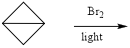
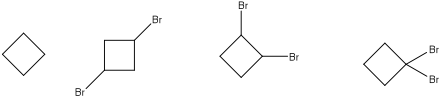
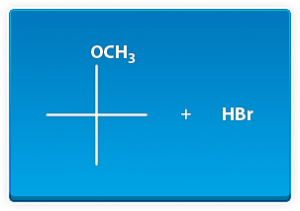
Predict the major product of the following reaction.


click on image to enlarge

click on image to enlarge

click on image to enlarge

A                     B                               C                              D
click on image to enlarge


Question 4:

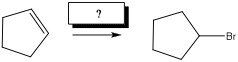
Describe the reaction conditions to produce the following product

click on image to enlarge

click on image to enlarge

  1. NaBr
  2. Br2
  3. H2SO4, Br2
  4. HBr


Answers and Explanations:

Question 1:  3

Difficulty Level: Easy

Explanation: Hammond’s Postulate describes the stability of the radical center is outweighed by the extreme exothermicity of radical chlorination (in contrast to bromination, which is endothermic), thus a mixture of chlorinated products is observed.


Question 2: 1

Difficulty Level: Medium

Explanation: Answers 2,3,4 all would start from alkanes containing secondary and tertiary carbon centers, which produce stable radical intermediates for halogenation.  Ethane contains two primary carbons coupled to the extreme endothermicity of iodination would yield very little product.


Question 3: B

Difficulty Level: Medium

Explanation:  The steric strain of the cyclopropane ring will drive the hemolytic cleavage of the 2,4 sigma bond with radical bromine to produce a radical intermediate on carbon 2.  Propagation of the radical bromine will result in the formation of product B.  Product C and D are not possible while the reagents to produce product A are not listed.


Question 4: 4

Difficulty Level: Hard

Explanation: Addition across the double bond with one equivalent of Br would more easily take place via an electrophilic addition using an equivalent of HBr, while radical bromination would produce dibromo-pentane.


There are multiple examples of this reaction to review in the StudyOrgo.com Study Mode. When ready, test your knowledge in the StudyOrgo.com Quiz Mode.

Not a member yet? Sign-Up today!

Free Radical Halogenation Module: Part 3: Stereoselectivity: Determining stereochemistry of carbon centers

Posted on October 2nd, 2013

This is the second part of a multi-part module on Free Radical Halogenation.

View the first part here: Part 1: The Mechanism

View the second part here: Part 2: Regioselectivity


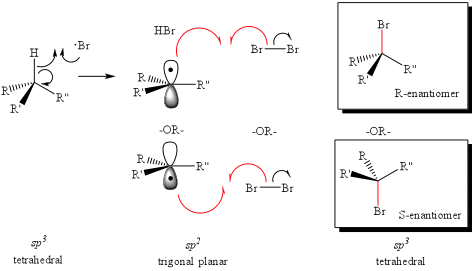
Radial intermediates (step 2a product) produce an sp2-like hybridization orbital with the lone electron in the vacant 2p orbital, therfore attack of the radical electron on the C-H bond can take place from either side of the molecule.  The result will always produce an RACEMIC MIXTURE (or equal amount) of the two enantiomers.


Free Radical Halogenation Module Pic 6

There are multiple examples of this reaction to review in the StudyOrgo.com Study Mode. When ready, test your knowledge in the StudyOrgo.com Quiz Mode.

Not a member yet? Sign-Up today!


Stay tuned for Part 4: Practice Quiz