

Archive for the "Organic Chemistry General" Category

Simplifying Ozonolysis Reduction and Oxidation

Posted on March 19th, 2013

Don’t loose sleep trying to understand Ozonolysis. Here is the StudyOrgo.com way of simplifying Ozonolysis:

  • Ozonolysis Overall Big Picture:
    • Reduction: Alkene   Ketones and/or Aldehydes
    • Oxidation: Alkene  Ketones and/or Carboxylic acids

  • Depicted here is an ozonolysis reduction reaction:

Ozonolysis - Reduction

    • A trick to figuring out the products of the Ozonolysis Reduction reactions is to simply squeeze two oxygens at the center of the starting alkene and that separates out your two products. We drew out the products facing each other to more easily visualize this.

  • Depicted here is an ozonolysis oxidation reaction:
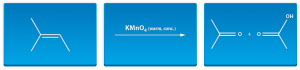
Ozonolysis - Oxidation

    • A trick to figuring out the products of the Ozonolysis Oxidation reactions is similar to the trick of Ozonolysis Reduction described above. Simply squeeze two oxygens at the center of the starting alkene and that separates out your two products. However, you must also add an oxygen before the hydrogen in any resulting aldehyde to make it a carboxylic acid. We drew out the products facing each other to more easily visualize this.

  • Key Tip: In general, ozonolysis reactions have two stages of adding reactants. The first is to add ozone (O3). The second determines whether the reaction will proceed as reduction or oxidation. A reactant such as (CH3)2S will promote reduction, while a reactant such as H2Oorwarm, concentrated KMnO4 will promote oxidation.

  • Beware! Ozonolysis problems can be challenging at times, and as such professors will test these problems in a variety of different ways. One classic way of testing ozonolysis is to provide the two products and ask the student to determine which starting alkene underwent ozonolysis to produce the given products. This is why the StudyOrgo.com unique reaction flashcard method is so valuable. We recommend that in addition to learning the reaction by revealing the first and second windows then determining the last window, that students reveal the middle and last windows and try to determine the first.
  • This can be practiced by creating custom quizes in the unique StudyOrgo.com Quiz Mode. Learn more about it and Sign-Up today!

Q & A: Organic Chemistry Mechanisms

Posted on February 13th, 2013

Question from one of our students: Is there any way to practice the mechanisms of the various organic reactions on this program?

Answer from one of our StudyOrgo.com Experts: Thank you for your inquiry. Yes, our program highlights the key points about mechanisms in the reaction description sections of the flashcards. These are written under the heading of “Mechanism Hint.” Additionally, the full mechanisms for the reactions of SN1, SN2, E1, E2 can be found in the dedicated StudyChart: “SN1 SN2 E1 E2 Comparison Chart.” We do not write out the entire mechanism for each reaction because this information can be easily obtained in any standard organic chemistry textbook. Our materials present key tips, tricks and hints that textbooks and professors don’t tell you but can be very valuable for exams. Additionally, mechanisms are typically a small portion of any classroom exam and it would typically inefficient to try to memorize every single mechanism. Rather, you may want to learn the ones that your professor highlights. Our materials will help you understand the reactions and other topics that will be tested in a very thorough manner. Take time to learn each reaction in Study Mode, then practice what you learned by creating custom quizzes in our Quiz Mode. If you every have any questions, please do not hesitate to contact us at any time.

Q & A: Why do you suppose no one has ever been able to make cyclopentyne as a stable molecule?

Posted on February 3rd, 2013

This question from one of our Twitter followers:

Answer from one of our StudyOrgo.com Experts:

That is a great question. Cyclopentyne is an extremely unstable molecule. Cyclopentyne has two main inherently unstable properties:

  1. it is a small membered ring structure
  2. is has a triple bond in the molecule

Let me explain each of these:

#1- it is a small membered ring structure
The smaller the carbon ring the more unstable it is. The reason for this is that the molecule cannot freely rotate about each bond. This is referred to as ring strain. The smallest carbon membered ring is cyclopropane which only has three carbons. This molecule has the highest ring strain of all the carbon rings. A five membered ring such as cyclopentyne is not too far from that.

#2- it has a triple bond in the molecule
The triple bond within the molecule is an example of sp hybridiation. You may recall that this geometry assumes a bond angle of 180 degrees. However when you force a triple bond into a ringed structure such as cyclopentyne, you are forcing the hybridization to assume a bond angle less than its preferred orientation of 180 degrees where the normal bond angle in such a structure is 108 degrees. That’s certainly much less than 180 degrees and that makes that carbon to carbon bond very unhappy!!

So, if the issue of ring strain wasn’t enough, now add on top of that an sp hybridized carbon to carbon interaction of the triple bond forced into a much smaller bong angle than it is accustomed to and you are left with a very unstable molecule. For these reasons no one has ever been able to make cyclopentyne as a stable molecule.

Why Is Organic Chemistry So Important To Medical School Admissions Committees?

Posted on January 28th, 2013

Do you need to know Organic Chemistry to be a great doctor?

No. But Medical School Admissions Committees sure do think so. It is well known that Medical Schools look closely at your Orgo grades from college when they consider you for admissions to their school. This is true. Let us explain.

Medical Schools like to see that an undergraduate student has excelled in Organic Chemistry. Some say it is because Organic Chemistry is a difficult subject and can help differentiate among those students who are stronger than others. Others say it is highly applicable to a typical medical school curriculum and thus those who have excelled in organic chemistry as an undergraduate are more likely to excel as a medical student. The bottom line is that for whatever reason, Organic Chemistry courses seem to produce a greater distribution of grades than do other pre-med courses such as Biology or General Chemistry. Therefore Medical School committees can use this to their advantage and thus can “weed” out weaker students. Are those students truly weak? Probably not. However when admissions committees need to review thousands of applications and can only accept a hundred or so students, they look for any possible way to dwindle down their heaping piles of applications.

Here are some other trends that committees tend to look for:

1) Good grades in both Orgo I and Orgo II

2) Improvement from Orgo I to Orgo II

3) Good grades in Organic Chemistry Lab

4) Good subject score on the MCAT Biologic Sciences demonstrates excellence in Organic Chemistry.

5) Strong letter of recommendation from an Organic Chemistry Professor (if applicable)


For these reasons, we feel it is important to concentrate while taking Organic Chemistry. Here are some tips:

1) Try to take and complete General Chemistry prior to taking Organic Chemistry

2) If possible, try to have a lighter course-load during the semesters that you take Organic Chemistry.

3) Scope out which professors teach the course you are looking to take depending on the time of the year. Some professors are “known” to be “easier” than others. Should it help to take Orgo I in the Spring and Orgo II in the fall, do so.

4) Obtain your resources early.

5) Develop a study plan and stay ahead of everyone else.

6) If you see that you are having trouble, try to identify so as early as possible.

7) Try to figure out what you professor places an emphasis on. That is what is more likely to be tested on your exams.

8) Ask your professor for old exams to get practice.


We here at StudyOrgo.com are aware of this. Therefore we have designed out study tools to combat the typical traps that students fall into. In addition, we highlight the common subjects that students have trouble with so as to separate you from all the rest of the class and get an edge on the competition.

So what are you waiting for? Sign-Up and begin acing Organic Chemistry today!

Q & A: Numbering Substituents in Organic Chemistry

Posted on January 8th, 2013

Question from one of our Twitter followers:

“While naming a complex organic compound, the substituent is ordered in which manner? The numbering.”


Answer from one of our StudyOrgo.com Experts:

Find the longest chain of carbons in the molecule and number them starting with the carbon closest to a branch.

Note: If there is a branch at the same point at either end, start numbering at the end closest to the largest branch. If the branches are of equal size at the same point at either end, start numbering at the end where the next branch is closer.


For access to our simple step-by step guide to naming in orgo and our exercises on this topic, sign-up for an account then visit Part 5 of our Summary Guide.