Archive for the "Organic Chemistry General" Category

Q & A: Lewis Structures and Resonance Structures

Posted on January 4th, 2013

Question from one of our Twitter followers:

“How to calculate the no.of non-bonding e- around “a” atom.& how to make sure whether the organic substance is major or minor”

Answer from one of our StudyOrgo.com Experts:

I think what you are asking about two things: how to draw a Lewis structure and how to determine which resonance structures are major and which are minor contributors.

First I will address the Lewis structure:

A Lewis structure is a way to draw out electrons and bonding by using dots. In a Lewis structure some of the electrons are “bonding electrons” and others are “non-bonding electrons” known as “lone pairs.” Here is a simple step by step process using CO2 as an example:

    1. Step 1: Determine the number of valence electrons an atom has to participate in bonding.
      1. Definition: Valence electrons are the electrons in the outermost shell of an atom. Some valence electrons participate in bonding to another atom. Others, known as lone pairs, do not.
      2. The number of valence electrons that participate in bonding for popular atoms are as follows:
        • C = 4
        • N = 3
        • O = 2
        • F = 1
        • H = 1
      3. For example: In CO2 we have C (draw 4 dots) and O (draw 2 dots per atom)
    2. Step 2: Place a dot around that atom for each valence electron that participate in bonding
      1. For example:  
    3. Step 3: Determine the lone pairs for a given atom:
      1. Remember: Lone pairs are a subset of the valence electrons that do not participate in bonding to another atom
      2. Lone pairs for popular atoms are as follows:
          1. C = 0
          2. N = 1 pair = 2 electrons
          3. O = 2 pairs = 4 electrons
          4. F = 3 pairs = 6 electrons
          5. H = 0
      3. For example, in CO2 we have C (no lone pairs) and O (two lone pairs per atom)
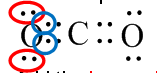
    4. Step 4: Place the lone pairs around the atom using a pair of dots to depict each lone pair.
      1. For example:
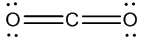
    5. Step 5: Wherever there is an atom bonding to another atom there are two dots between them, one from each atom. You may decide to convert this pair of electrons into a line to denote a bond.
      1. For example: 
    6. How do I figure out an atom’s formal charge?
      1. Step 1: Count the atom’s lone pair electrons
      2. Step 2: Count one from each pair of electrons that particular atom is using to bond to another atom
      3. Step 3: Add the number you get from Step 1 to Step 2
      4. Step 4: The formal charge is whatever you need to do to the number you got from step 3 to get to the atom’s group number on the periodic table
      5. For example: Let’s use an O atom in CO2 as an example
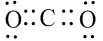
 

Add the lone pair electrons (4) to one from each pair of bonding electrons (2) = 6

Since oxygen is in group 6 in the periodic table the formal charge is 0 (zero). (You do not need to do anything to the number you get from step 3 to get to the atom’s group number on the periodic table)


Next I will address the Resonance Structures:

  1. A drawn structure with a double bond on its own does not completely represent the structure of a given molecule
    1. There can be more than one possible structure for the same molecule!
    2. The actual structure is the average of all of the resonance structures
  • Why resonance?
  1. Resonance spreads the charge over two atoms which makes the structure more stable
  • How do I figure out resonance problems? Follow these simple rules:
    1. Rule #1: Try moving around electrons.
      1. When moving electrons use an arrow to demonstrate where the electrons are going.
  • Electrons can be moved around in one of two ways:
  1. Move double bond electrons
  2. Move lone pair electrons
    1. Rule #2: The number of unpaired electrons must remain the same
    2. Rule #3: Figure out which of your drawings represent the major and minor structures
      1. Major resonance = the resonance contributors that are more stable as they have the least energy. Low energy structures satisfy as many of the following as possible:
        1. There are as many octets as possible
        2. There are as many bonds as possible
        3. There are as few lone pairs as possible
        4. Any negative charges are placed on the most electronegative atoms
          1. Most electronegative F > O > Cl > N > C least electronegative
        5. There is the least separation of charge amongst the structures
      2. Minor resonance = the resonance contributors that are less stable as they have the most energy. High energy structures do not satisfy as many of the above guidelines
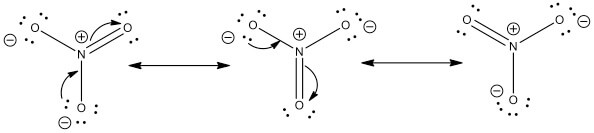
    3. Example: NO3-
      1. In the following example NO3- is drawn out showing three different resonance structures. Please remember that while electrons are moving around no atoms are moving.
      2. The arrows show the movement of the electrons to show how to arrive at the next structure moving from the left to the right of the screen.
      3. Since all three structures satisfy the same guidelines to the same extent as outlined above, all three are equal contributors. However this is often not the case and will be seen in the next exercise set.
 

Happy Holidays from StudyOrgo.com!

Posted on December 26th, 2012

Dear Organic Chemistry Students,

Congratulations to our students who have contacted us to share their wonderful success with this past semester! We are very proud of our students and we are glad that we were able to help provide study aids that gave our customers an edge on the competition to ace their classes this past Fall semester.

We are continually making updates and changes and we are very much looking forward to next semester. Many students who took Orgo I this past semseter will find that they can still continue to use our program into the next semester. Altough we focus on topics typically covered during first semester organic chemistry, we also highlight many reactions and topics covered during second semester. So be sure to review your course syllabus and compare it to Wha’ts Covered in our program. If you are running close to your end date for your access or if yours has already expired, be sure to purchase additional studying time by logging in to your account homepage.

Of course we are very thankful for the many success stories we have heard from our students, and we would be very interested to hear yours! Feedback is not only important for our program development but it is also vital to future students as listening to stories from peers can help. Please submit your story to us here, and please be as detailed as possible. We are also looking to feature some select students on our site by using our new video testimonial option. Should you be interested in this please contact us.

As always, please feel free to contact us at anytime with any questions you may have.

We want to wish you and your family and happy and healthy new year filled with organic chemistry success!

-The StudyOrgo.com Team

Epoxide Opening with Acids, Bases and Grignards

Posted on December 7th, 2012

We here at StudyOrgo.com think it is very important to help students make connections when studying organic chemistry. When professors teach you about reactions, or you read a textbook about isolated reactions, one rarely picks up the underlying connection between related reactions. One reason that professors do not teach you these things is because it becomes a highly-testable concept that you have to “figure out on your own.” One of our main goals is to identify key connections and present them for you throughout our materials.

Take, the opening of an epoxide as an example. The reagent will attack an epoxide at varying parts of the substance depending on the type of reagent. For example, acids attack the most substituted position on the epoxide, bases attack the least substituted position and grignards also attack the least substituted position.

So here it is in plain, simple English:

  • Acid catalyzed epoxide ring opening: attack the most substituted position on the epoxide.
  • Base catalyzed epoxide ring opening: attack the least substituted position on the epoxide.
  • Grignard epoxide opening: attack the least substituted position on the epoxide

To review these key concepts with reaction examples, visit our reaction flashcard “Study Mode” (members only) which can be accessed from the account homepage.

Try:

1) Epoxides category- Epoxide Opening Reactions (7 reactions)

2) Alcohols category – Grignard Epoxide Opening Reaction

Then practice by creating your own custom quizzes by visiting our “Quiz Mode” homepage (members only also).


Think About Integrating Reactions

Posted on November 30th, 2012

December is the last month for organic chemistry courses for a lot of universities. So by entering the month of December – you are in the home stretch and you can sense the end is near. Most of you are probably very excited for that. At this point, try to begin integrating concepts as you approach possibly one of your last few exams or quizzes prior to the final exam.

You have learned many reactions at this point and likely feel that you have studied each relatively independant of the other. Now would be a good time to see if there are any similarities in between different reactions. This is especialy important because as you learn more, things start to blur a bit and seem to overlap with one another. That is because it does!

One good way to see how reaction relate to one another is to make lists. Some examples:

1) Make a list of all the possible ways you can make alkenes

2)  Make a list of all the possible ways you can make alkynes

3)  Make a list of all the things you can do with an alkene

4)  Make a list of all the things you can do with an alkyne

and so on…

Another way to integrate reactions is to draw out a map. Many students do not do this because it is extremely time intensive and cumbersome. Good new is that StudyOrgo.com has got you covered. Our team already has drawn out a beautifully color-coded Reaction Roadmap that illustrates these interconnections. StudyOrgo.com members have access to this by visiting:

http://www.studyorgo.com/roadmap.php

Not yet a member? No problem click here to sign-up.

Happy Integrating!

-The StudyOrgo.com Team

Reaction Intermediates: Radical, Carbocation, Carbanion

Posted on November 26th, 2012

It is important to know the hierarchy of Reaction Intermediates such as Radicals, Carbocations, Carbanions.
Here we present a quick guide to Reaction Intermediate hierarchies.
The Big Picture: Radicals and Carbocations prefer a greater degree of alkyl substitution. While, Carbanions are the opposite: Carbanions prefer a lesser degree of alkyl substitution. However, all three prefer the allylic position the most!
This is some of the information presented in Part 10 of our Study Guide: one of the many resources available to StudyOrgo.com members. Learn more about it here: How It Works.
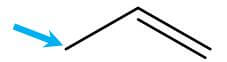
    1. Allylic position
      1. Definition: The position immediately next to a double bond
      2. Image: The arrow points to the allylic position: 
    2. Reaction Intermediates
      • Radical
        • Typically electrons come in pairs. However there are unpaired electrons known as radical electrons. These are usually just called radicals.
        • Radical stability
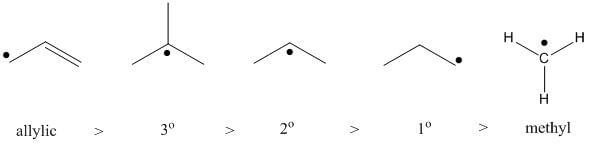
          1. Radicals prefer a greater degree of alkyl substitution. Even more so, radicals prefer to be in the allylic position.
          2. Therefore here is the hierarchy of radical intermediate stability:

      • Carbocation
        • Carbocations serve as electrophiles in reactions. They will attract electrons easily as the carbon is deficient in electrons.
        • Carbocation stability
          1. Carbocations prefer a greater degree of alkyl substitution. Even more so, carbocations prefer to be in the allylic position. Therefore here is the hierarchy of carbocation intermediate stability:

      • Carbanion
        • Carbanions serve as nucleophiles in reactions. They will donate electrons easily as the carbon has excess electrons.
        • Carbanion stability
          1. Carbanions prefer a lesser degree of alkyl substitution. Even more so, carbanions prefer to be in the allylic position. Therefore here is the hierarchy of carbanion intermediate stability:

Join StudyOrgo.com today and save 10% using coupon code “acespring”.  We have the highest pass rate of any organic chemistry study program and we guarantee you pass.