Free Radical Halogenation

Posted on September 22nd, 2015

Another common mechanism that is covered in the first weeks of organic chemistry is the free radical halogenation of alkanes.  This mechanism utilizes the homolytic cleavage (one electron per atom) property of halogens when exposed to heat or ionizing radiation (i.e. hv), which is a popular mechanism for future reactions in the course.  Radical halogens can extract the proton from a C-H bond to produce the corresponding acid and generate a radical carbon center.  In this article we will discuss all of the tips and tricks to getting an ‘A’ on your racical halogenation questions.  Sign up with StudyOrgo today for more in-depth mechanism coverage and answers to all of your organic chemistry questions!

Generating a radical halogen: there are THREE critical steps to free radical reactions.

1) Initiation: The Br2 single bond is broken by high energy ligh (hv) to form radicals placing one electron on each atom.

halogen 1

2) Propagation: (Hint: One radical reacts with a single bond to form another radical, thus propagating the radical species to drive the reaction forward.

  1. a) Radical Br abstracts one hydrogen from a C-H bond in propane to form radical propane and HBr.

    halogen 2
  2. b) Radical propane asbracts one Br from Br2 to form the bromoalkane and radical Br, thus restoring the reactants for another round as shown in step 2a.halogen 3

3) Termination: Any two radicals combine to form a single bond.  These species will be in low abundance. Hint: Radicals are destroyed by combining two radicals to form a single bond.  This eliminates the radical necessary for radical alkane formation (green boxes) as shown in step 2a and ends the reaction.
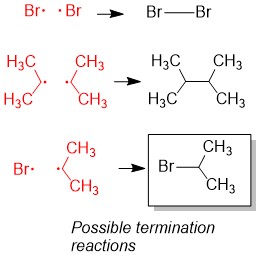
halogen 4

Regioselectivity: How to determine the major product

Radical bromination will always replace the C-H bond on the MOST substituted carbon center because the stability of the radical intermediate is higher with increasing substituents on the carbon center.

This selectivity is the same, but a weaker consideration, for radical chlorination which obeys Hammond’s Postulate, which says that stability of the radical center is outweighed by the extreme exothermicity of radical chlorination (compared to bromination), thus a mixture of chlorinated products is observed.
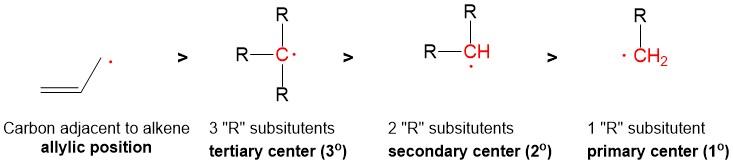
halogen 5

Stereoselectivity – How to determine the stereochemistry of carbon centers

Radial intermediates (step 2a product) produce a sp2-like hybridization orbital with the lone electron in the vacant 2p orbital, therfore attack of the radical electron on the C-H bond can take place from either side of the molecule.  The result will always produce a racemic mixture (or equal amount) of the two enantiomers.
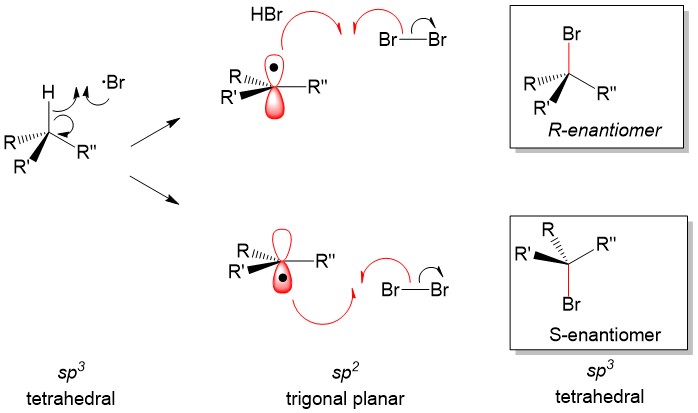
halogen 6


The SN1 Reaction

Posted on September 8th, 2015

Another reaction commonly covered in the first weeks of organic chemistry is the SN1 reaction. The SN1 reaction introduces you to repetitive concepts and rules you will encounter all semester, this time focusing on carbocation formation and reactivity. In this article, we will review the important topics of an SN1 reaction.  Sign up with StudyOrgo today to get detailed reaction mechanisms and explanations to prepare you to ace your next exam!

Alkyl halides as SN1 substrates

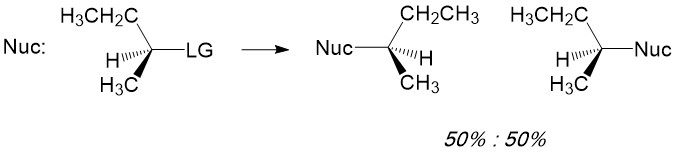
One of the most reactive molecules involving substitution reactions via SN1 are 2° and 3° alkyl halides.  However, there are a number of considerations to keep in mind to determine if this mechanism of substitution describes your reaction. First, let’s look at a simple SN1 reaction; a sec-butyl halide (a 2° methyl-ethyl carbon center).

sn1 figure 1

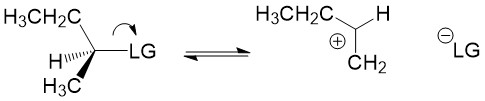
Carbocation formation and stability: Let’s break down the reaction name more simply.  The term SN1 reaction gives you 3 pieces of information, first the ‘S’ indicating ‘substitution’, the ‘N’ denoting the reaction involves a nucleophile and ‘1’ describing the process as unimolecular – meaning only the formation of the reactive substrate intermediate determines the rate of reaction.  This process is referred to as the rate determining step of the reaction, and can be thought of as the ‘bottleneck’ in the reaction. The leaving group will break the bond to carbon and take the electrons for the bond with it forming a carbocation intermediate.  Halogens are good leaving groups because of the inductive effects (or electron withdrawing potential) of the halogen atom and is the characteristic of good leaving groups. Carbocation formation is the first, and rate determining step, in the reaction.

sn1 figure 2

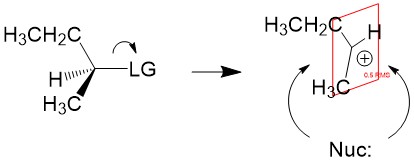
Product formation and racemization: Once the leaving group bond is broken, stability of the carbocation is the factor that determines if this mechanism occurs.  The more substituted the carbon center, i.e. 2° and 3°, the more stabilized the carbocation becomes as the positive charge becomes delocalized to the other carbons. Following formation of the carbocation, it will then react with the nucleophile.  Since the carbocation assumes a planar shape, attack by the nucleophile can occur from either side of the plane.  This leads to formation of a mixture of enantiomers, referred to as a racemic mixture.  This is in contrast to SN2 which will only produce the inverted stereoisomer of the reactant.

sn1 figure 3

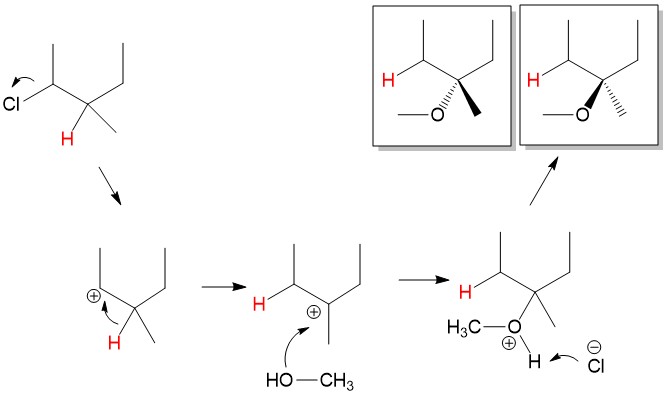
Carbocation Rearrangement: As mentioned before, stability of the carbocation is the key step in determining rate and completion of SN1 reactions.  In some instances, the leaving group is bonded to a carbon center than neighbors a more substituted carbon center.  Let’s consider the reaction below, chloride leaves 2-chloro-3-methylpropane to form a 2° carbocation. The neighboring carbon center is 3°, and would make a more stable carbocation.  In this instance, the neighboring hydrogen will shift to the 2° carbocation to form a new 3° carbocation, which is much more stable in a process referred to as a 1,2-hydride shift. Attack of the methanol hydroxyl group on the carbocation followed by proton abstraction by chloride leads to formation of the 3-methoxy-3-methylpropane product.

sn1 figure 4

The SN2 Reaction

Posted on August 31st, 2015

The start of first semester organic chemistry can be an information overload.  For the first few classes, you will review general chemistry concepts and then… the reactions start coming!  One of the first reactions that will be covered is the SN2 reaction, mainly because it is relatively straight forward and a good tutorial for how to describe reaction mechanisms.  In this article, we will review the important topics of an SN2 reaction.  Sign up with StudyOrgo today to get detailed reaction mechanisms and explanations to stay on top of your class!

Alkyl halides as SN2 substrates

One of the most reactive molecules involving substitution reactions are alkyl halides.  However, there are a number of considerations to keep in mind to determine if the SN2 mechanism describes your reaction. First, let’s look at a simple SN2 reaction; methyl chloride and NaOH to form methanol and NaCl.

sn2 figure 1

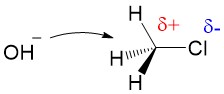
Let’s break down the reaction mechanism into the basic elements.  An SN2 reaction gives you 3 pieces of information, first the ‘S’ indicating ‘substitution’, the ‘N’ denoting the reaction involves a nucleophile and ‘2’ describing the process as bimolecular – meaning both the substrate and the nucleophile determine the rate of the reaction.  The hydroxide will attack the carbon center and form a new bond with carbon (which makes it the nucleophile) and the chlorine atom will leave the carbon center with the electrons from the C-Cl bond (which makes it the leaving group).

Inductive effects of leaving groups: Chloride is a good leaving group because of the inductive effects (or electron withdrawing potential) of the halogen atom.  This is the characteristic of good leaving groups.  The electronegativity of chlorine makes the carbon center slightly electrophilic, meaning it has a partial positive charge, which is strongly attracted to electron-rich nucleophiles.

sn2 figure 2

Strong bases as a nucleophile: In order to form a new bond with carbon, a good nucleophile has to be electron rich.  The strong basic properties of NaOH make the charge on oxygen negative, and thus a good nucleophile.  Likewise, the poor basic properties of Cl anion make it an excellent leaving group.  Below is a chart to help illustrate the contrasting properties of nucleophiles and leaving groups.

sn2 figure 3

Inversion of stereochemistry due to geometry of attack: Once the nucleophile attacks the carbon center, a partial formation of C-O bond and breaking of C-Cl bond occurs in a concerted (or instantaneous) fashion, depicted below.  Because the angle of attack for the nucleophile has to be opposite of the leaving group, the OH adds to the opposite side of the carbon center, causing an inversion of stereochemistry.  This is an important clue in determining if reactions occur using the SN2 mechanism.

sn2 figure 4

Drawing Organic Molecules

Posted on August 24th, 2015

Drawing organic molecules is essential to getting a great grade in organic chemistry.  Often times, professors will deduct many points from students who understand the material just because their drawing are horrible!  Unfortunately, this class can be as much about art as the science but remember it is important not just to understand but to communicate that you understand!  Only lots of practice and these tips from StudyOrgo will guarantee you will get all the preparation you need to ace the next exam.

Sign up for a membership with StudyOrgo today to get help with all of your organic chemistry questions!

Two-dimensional line structures

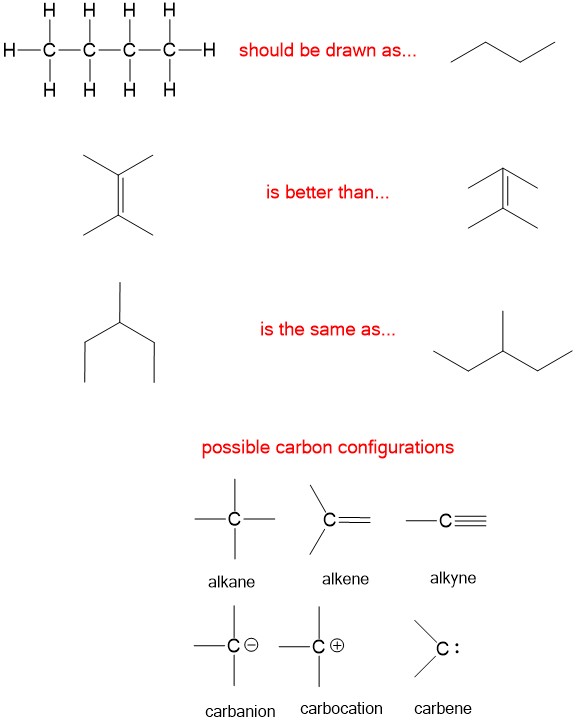
The simplest drawings in organic chemistry are line drawings.  General chemistry often indicated each element bond in a molecule.  Organic chemists use complicated molecules and time is precious.  Therefore, a quick way to draw hydrocarbons was necessary. There are a few rules to help you draw the appropriate structures in organic chemistry.

  1. Draw carbons in a zigzag pattern, points are carbon atoms and lines are bonds. All other atoms bonded to carbon, unless otherwise stated, are hydrogens.
  2. Draw all bonds as far away as possible.
  3. Drawing single bond carbons in any direction is equivalent.
  4. Never, never, never draw more than 4 bonds to carbon!!!

drawing 1

Three-dimensional structures

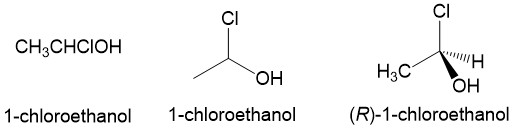
Dash and wedge: One piece of information that is lost in the line drawing of molecules is the three-dimensional arrangement of the substituents around carbon atoms.  This becomes very important when dealing with stereocenters, which will have two possible enantiomers.  To describe this arrangement, chemists use the dash and wedge model.  Imagining the paper (or computer monitor in this case) is the mirror plane, the dash indicates a bond below the plane and the wedge indicates a bond above the plane.  Looking at the example below, we see that the stereochemistry of 1-chloroethanol is ambiguous when drawn as a line structure.  Drawn as a dash and wedge, it becomes very clear that the stereoconformation shown is R-1-chloroethanol.

drawing 2

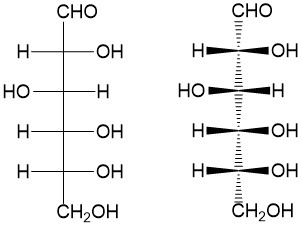
Fischer projection: For acyclic molecules, especially those with many substituents, chemists will use the Fisher projection to make drawing the molecules more rapid.  The convention depicts bonds drawn from top to bottom are in the dash conformation while the bonds drawn from left to right are in the wedge conformation.  This easily, and quickly, indicates the stereochemistry without the cumbrous bold and dashed bonds, as shown to the right.

drawing 3

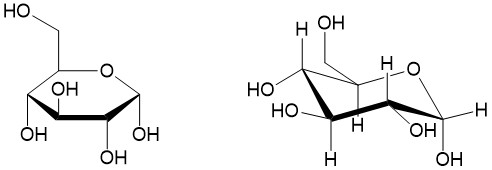
Haworth projection: For cyclic molecules, chemists utilize the Haworth projection. The projection depicts the ring on an angle, half above the plane of the paper and halve behind the plane of the paper.  This allows the substituents to be drawn in the plane of the paper.  Take for instance glucose, shown below.  The Haworth projection to the left is commonly drawn to depict whether the alcohol groups are above or below (alpha- and beta-, respectively) the plane of the ring.  A more comprehensive drawing places the ring in a chair conformation, which will indicate whether the substituents are in the equatorial or axial.  This allows one to determine the stereochemistry of each stereoisomer.

drawing 4

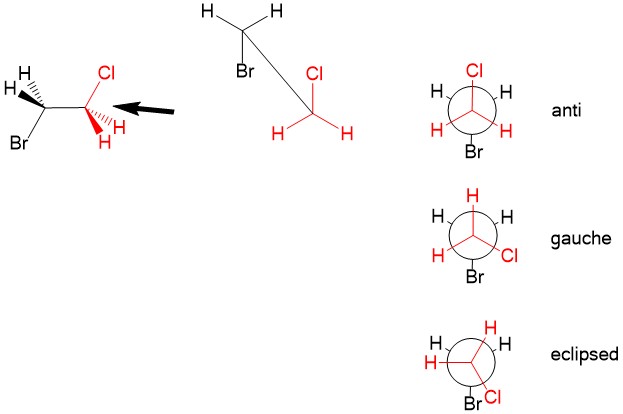
Newman projection: Recall that even with three-dimensional configuration of atoms, there is free rotation about sp3 hybridized bond.  While it is customary to draw the structure in the lowest energy arrangement, we sometimes consider other rotations about a C-C bond that could affect reaction mechanisms.  For this, we utilize the Newman projection.  Looking “down the barrel” of the sp3 bond, we place carbon #1 substituents in the front (in red) and carbon #2 substituents in the back (black).  The lowest energy conformation is to arrange the substituents of the two carbons in the ‘anti’ configuration, places Cl and Br opposite of each other.  We can rotate one of the atoms such that steric hindrance of the halogen orbitals causes strain.  It becomes higher in energy when at ‘gauche’, when the Cl and Br are not anti or in the highest energy ‘eclipsed’ configuration, when Cl and Br on top of each other.  Temporary rotation of the bonds can be important considerations when studying reaction mechanism in the future!

drawing 6

Chirality and Assigning Stereochemistry to Molecules

Posted on August 11th, 2015

One of the most important skills to master in organic chemistry is the ability to assign stereochemistry.  We at StudyOrgo have devised clear cut explanations of these difficult concepts for students to maximize their time studying and learn difficult concepts quickly and easily. Sign up with StudyOrgo.com today for all of your organic chemistry studying needs!

Chirality is an important aspect of life.  This is so because many of the basic molecules used in living cells, in particular amino acids that form enzymes, are also chiral. Chirality imparts asymmetry on our molecules, allowing them the ability to recognize “handedness” and further add to the complexity and specificity of reactions. As organic chemists, we must pay constant attention to the chirality of molecules both before and after reactions, less the compounds lose their biological or chemical activity.

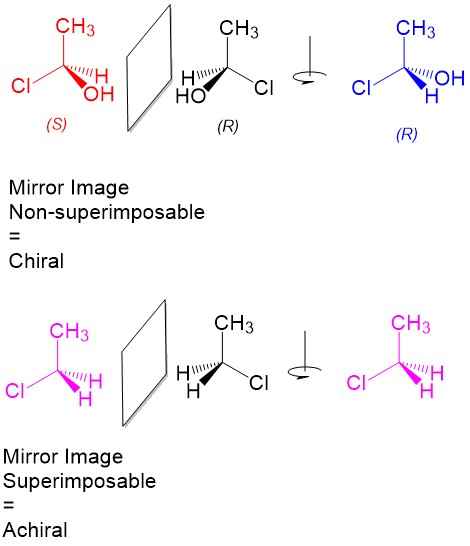
Chirality is defined as any object in which the mirror images are not superimposable. A good example is your hands; they are mirror images but not superimposable. Translating this to organic molecules, a stereocenter is a carbon center with 4 unique substituents that are arranged such that the mirror image is not superimposable. Thus, they “look” like to different molecules although they have the same substituents. If we alter the arrangement of the substituents, we can always come up with 2 arrangements for each substituent, R or S configuration.  Thus, each stereocenter must have 2 stereoisomers.

chiral 1

In order to determine whether the sterecenter is the the R or S configuration, there are a series of steps to follow.

  1. Identify the stereocenter as 4 unique substituents attached to the chiral center
  2. Assign priority based on atom atomic number, highest (1) to lowest (4) weight.
  3. If two atoms are same, move to next bond to find first point of difference
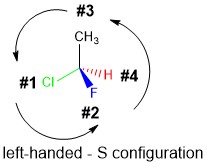
  4. Rotate the molecule so that Priority 4 atom is in the hashed wedge position.
  5. Determine the Priority sequence 1-2-3 rotates to the left (S) or the right (R).

chiral 2

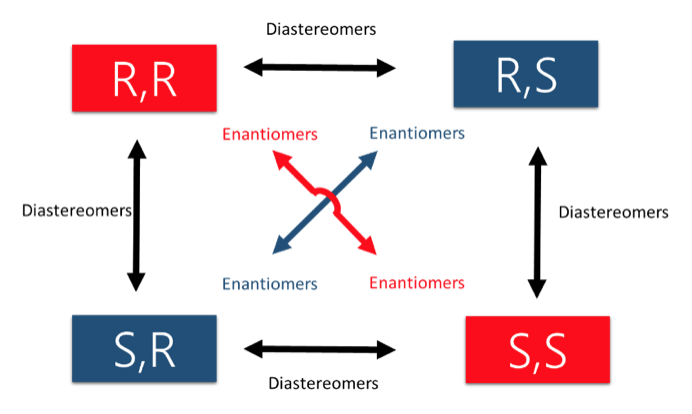
Lastly, an important concept to keep in mind is that as molecules become more complex, they also can acquire more stereocenters.  Keeping in mind that each stereocenter can produce 2 stereoisomers, we describe possible stereoisomerism using the 2n rule. Let’s examine a molecule with 2 stereocenters, following the 2n rule that gives us 22=4 stereocenters.  The possible combinations are listed below.

Screen Shot 2014-12-18 at 1.00.28 PM

We now introduce the last concept to stereochemistry which is the difference between enantiomers and diastereomers.  Enantiomers are molecules with exactly opposite stereoisomers.  For example, the enantiomer of the molecule with stereochemistry R,R would be S,S.  The relationship between molecule R,R and R,S is what is described as diastereomers, which differ in some but not all stereocenters.

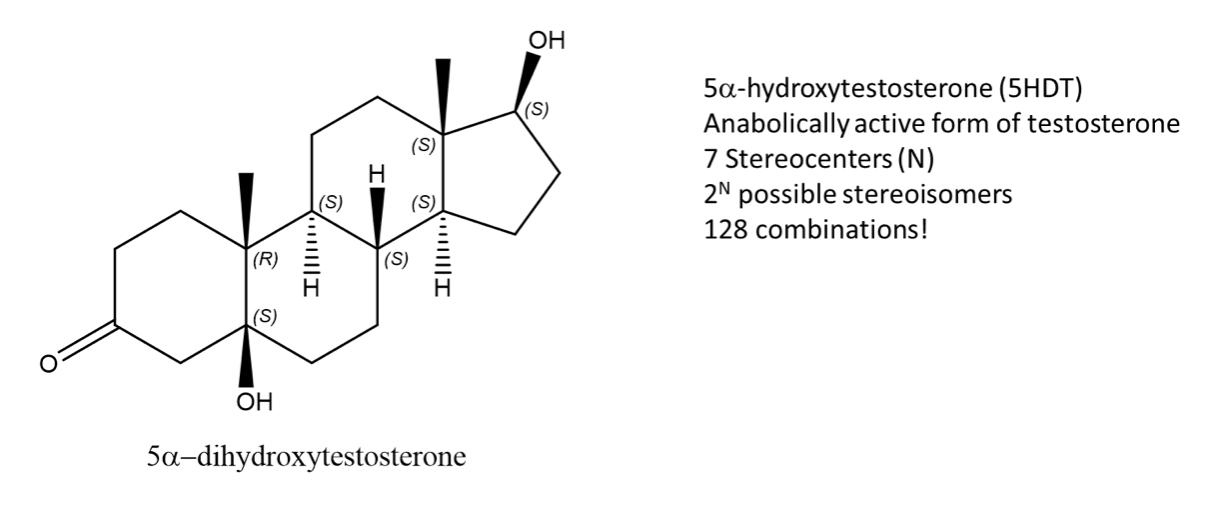
Let’s consider the biologically active form of testosterone, 5-DHT which is shown below.  We indicate that it has 7 stereocenters in the molecule.  Applying the 2n rule, we calculate 128 possible stereoisomer combinations.  That concludes that while testosterone has 1 enantiomer, it has 126 diastereomers and remember…only 5-DHT works on our bodies!

Screen Shot 2014-12-18 at 1.02.36 PM