Free Radical Halogenation Module: Part 1: The Mechanism

Posted on August 29th, 2013

This is the first part of a multi-part module on Free Radical Halogenation.


There are THREE critical steps to free radical reactions – Memorize!

1) Initiation: The Br2 single bond is broken by high energy ligh (hv) to form radicals placing one electron on each atom.

Free Radical Halogenation Module Pic 1

2) Propagation: (Hint: One radical reacts with a sigle bond to form another radical, thus propigating the radical species to drive the reaction forward.

a) Radical Br abstracts one hydrogen from a C-H bond in propane to form radical propane and HBr.

Free Radical Halogenation Module Pic 2

b) Radical propane asbracts one Br from Br2 to form the bromoalkane and radical Br, thus restoring the reactants for another round as shown in step 2a.

Free Radical Halogenation Module Pic 3

3) Termination: Any two radicals combine to form a single bond.  These species will be in low abundance. Hint: Radicals are destroyed by combining two radicals to form a single bond.  This eliminates the radical necessary for radical alkane formation (green boxes) as shown in step 2a and ends the reaction.
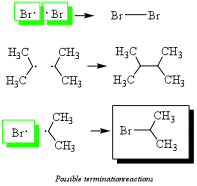
Free Radical Halogenation Module Pic 4


There are multiple examples of this reaction to review in the StudyOrgo.com Study Mode. When ready, test your knowledge in the StudyOrgo.com Quiz Mode.

Not a member yet? Sign-Up today!
Energy Diagram Module Series- Part Four: Practice Quiz

Posted on August 19th, 2013

This is the final part of a four part series in the Energy Diagram Module.

Click on the following link to see earlier parts:

Part 1

Part 2

Part 3


For each of the following questions- choose the best answer among the four answer choices.

Scroll to the bottom to see the answer key.


Question1

The net amount of heat released from the formation of products in a reaction is represented by _______________.

A) Temperature

B) Activation Energy

C) Heat of Reaction

D) Entropy


Question 2

A transition state represents _______________.

A) The highest potential energy molecule of the mechanism

B) The lowest potential energy molecule of the mechanism

C) The a molecule that does not occur in the reaction

D) A new reactant introduced to the reaction.


Question 3

A high energy, sometimes isolatable, chemical species during the course of reactants to products is referred to as a _______________.

A) Product

B) Midpoint

C) Transition State

D) Intermediate


Question 4

Refer to the Gibbs Free Energy Equation

ΔG0 = ΔH0 – TΔS

Under which circumstance will DG0 ­NEVER be spontaneous. (Hint: spontaneous reactions have a negative ΔG0)

A) ΔH0 < 0 and ΔS < 0

 ΔH0 > 0 and ΔS < 0

C) ΔH0 > 0 and ΔS > 0

D) ΔH0 < 0 and ΔS > 0


ANSWER KEY:

1. C

2. A

3. C

4. B

Energy Diagram Module Series- Part Three: Intermediates and Rate-Limiting Step

Posted on August 12th, 2013

This is part 3 of a four part series in the Energy Diagram Module. Stay tuned for Part 4!

 Click on the following links to see earlier parts:

Part 1

Part 2

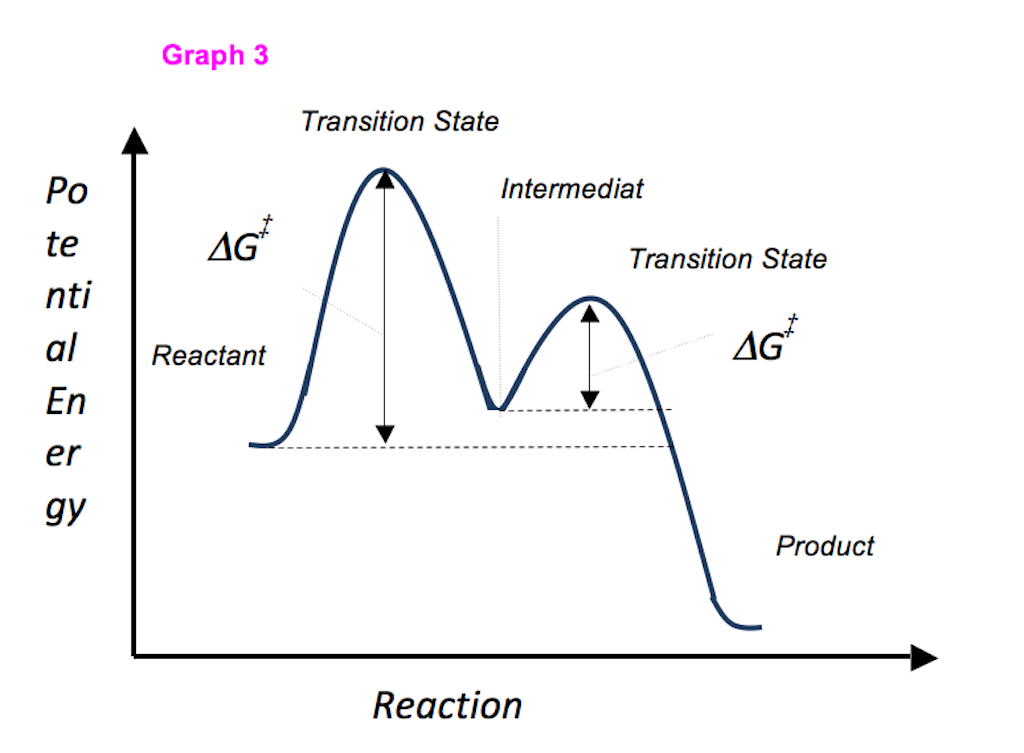
Sometimes reactions are more complex than simply a transition state (Graph 3), which would represent a single step in the reaction mechanism.  You will soon see most reactions proceed in a multistep fashion.  In this case, reaction mechanisms often form lower energy and sometimes isolatable intermediates.   The reaction intermediate occurs between two transition states however its energy is still higher than either products or reactants.  Note that the activation energy between reactant and the intermediate (step 1, ΔG1) is greater than the activation energy between the intermediate and the products (step 2, ΔG2). Thus it can be said that step 1 is the rate-limiting step of the reaction, which is the highest energy barrier that must be overcome.


StudyOrgo.com - Graph 3


Graph 3

(click on image to enlarge)


Energy Diagram Module Series- Part Two: Gibbs Free Energy and Spontaneity

Posted on July 29th, 2013

This is part 2 of a four part series in the Energy Diagram Module. Stay tuned for the other parts!

To see part 1 click here.

In order to talk about energy of the reaction, a few key concepts are needed.

  • If the products have less potential energy than the reactants, the reaction will release a net amount of energy (an exothermic reaction).
  • If the products are higher in energy than the reactions, the reaction will consume a net amount of energy (an endothermic reaction).

But, in order to predict how well a reaction will progress, or how spontaneous the reaction will be, enthalpy is insufficient to make this estimation.  Therefore, we rely on the thermodynamic calculation of Gibbs Free Energy (ΔG0) which is represented by the equation;

ΔG0 = ΔH0 – TΔS

The components of Gibbs Free Energy are:

  • Enthalpy, ΔH0 The heat consumed or released by the reaction.
  • Temperature, T – Temperature of the system.
  • Entropy, ΔS.  The change in the degree of disorder.

The sign of the reaction indicates the release (negative) or absorption (positive) of heat during the reaction. Therefore, if ΔG0 is negative the reaction is always spontaneous.  Similarly, if ΔG0 is positive the reaction is never spontaneousWhen ΔG0 equals zero, the reaction is at equilibrium. In accounting for these additional thermodynamic properties using Gibbs Free Energy, different terms are used.

  • If a reaction has a negative  ΔG0 , it is therefore spontaneous and is said to be exergonic.
  • Conversely, a reaction that has a  positive  ΔG0  is not spontaneous is considered endergonic.


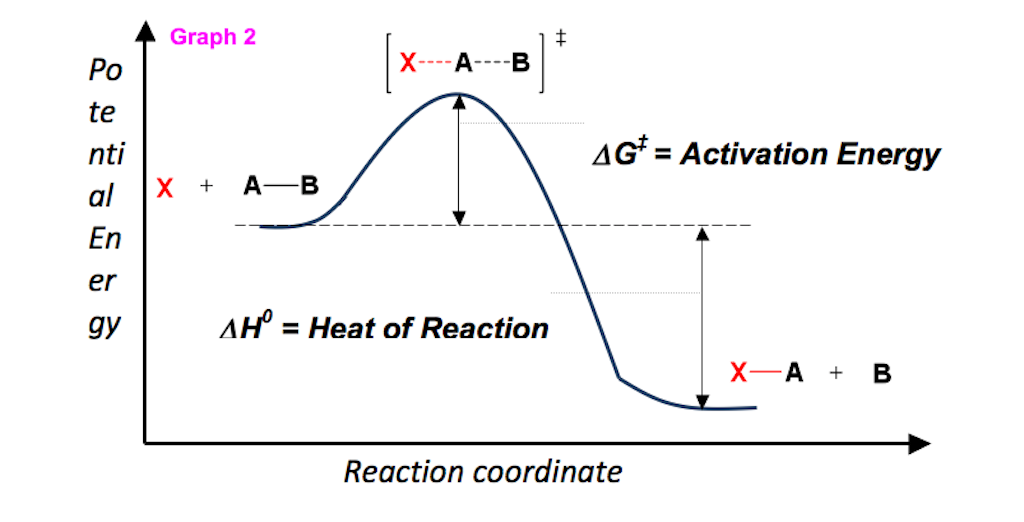
StudyOrgo.com - Graph 2

Graph 2

(click on photo to enlarge)

With the addition of the temperature variable in the Gibbs Free Energy equation, it is easy to see that an endergonic reactions can be driven forward simply by increasing the temperature of the reaction so that the term TΔS is more negative than ΔH0, thus making ΔG0 negative and making the reaction spontaneous!

Energy Diagram Module Series- Part One: Introduction

Posted on July 23rd, 2013

This is part 1 of a four part series in the Energy Diagram Module.

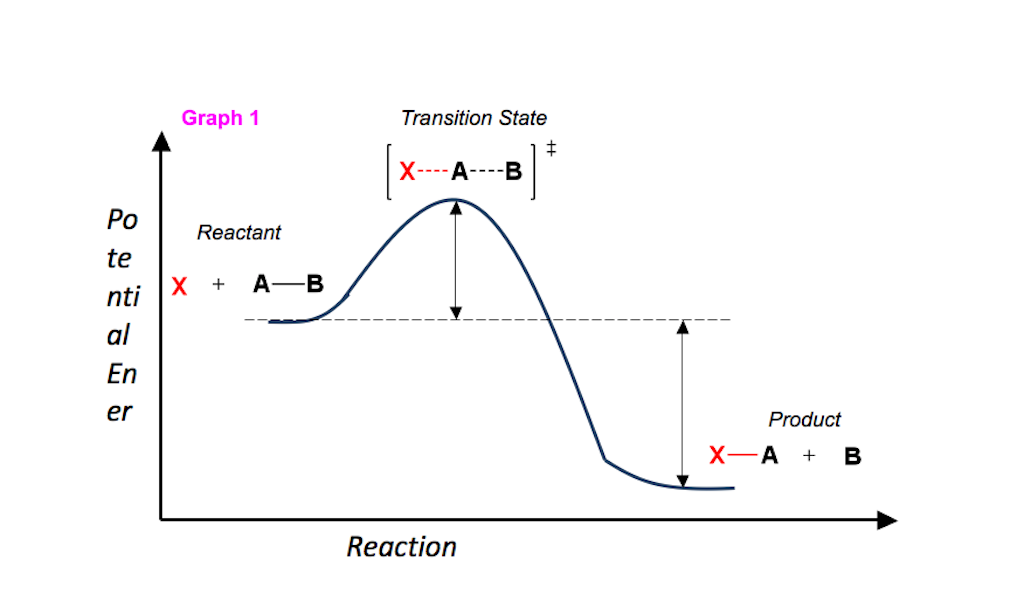
In order to talk about reaction mechanisms, we have to first understand what makes up a reaction. It may help to think of a reaction as a landscape.  Let us look at the components in Graph 1 below.

  • the x-axis as the reaction proceeds (the reaction coordinate).
  • The potential energy of the molecules throughout the reaction along the y-axis.
  • The shape of the line graph represents the pathway (or mechanism) by which the reactants must take to reach the products.
  • Using the landscape analogy, reactants and products that are stable can be thought of as the “valleys”, which have some potential energy (refer to Graph 1).
  • As reactants collide during the course of a reaction, they must go over a “hill” in order to each the product of the reaction.  This hill represents the energy needed to break the existing bonds in the reactions (the activation energy, ΔG)
  • At the top of the hill, some hybrid molecule (the transition state, [ ]) is formed which represents the simultaneous (often referred to as concerted) bond breaking and bond forming.  Because of the hybrid nature of the molecule, transition states are NOT isolatable.

The activation energy is usually provided by sum of the surrounding system and the collision of the reactant molecules. For reactions with high activation energy barriers, a Bunsen burner or heating element can be used to add energy.  Looking at Graph 2, as transition states form, the reaction can “roll” downhill both ways, backwards to reactants or forwards to products. As products begin to form, which as illustrated is much lower in energy than the reactants, the net release of energy (the heat of reaction, ΔH0) is released back to the surrounding system in the form of heat (enthalpy).

StudyOrgo.com - Graph 1

Graph 1

(click on photo to enlarge)

StudyOrgo.com - Graph 2

Graph 2

(click on photo to enlarge)