Archive for the "Organic Chemistry General" Category

Intermolecular Forces Review

Posted on September 5th, 2016

Studying ahead for Organic Chemistry this Fall semester is a good way for reaching and maintaining a great grade in this class.  Most students find the pace of this class very challenging compared to other courses.  This is because while there is a lot of information to learn, it also builds on previous concepts from general chemistry, a course most students want to forget!

But don’t worry!  StudyOrgo has you covered.  Our Editors have spent years tutoring and teaching Organic Chemistry to students and we have seen all of the pitfalls common to the first few weeks of the semester.  Our online platform allows members to learn organic chemistry concepts and mechanisms quickly and the material presented in an easy-to-follow format. Follow along with us and sign up with StudyOrgo today to help prepare you for all of your Organic Chemistry questions.

One of the concepts you will need to have mastered before you  begin the class is Intermolecular Forces.

Permanent covalent bonds hold atoms together by electrostatic interactions between atoms. But these bonds can be very different. As such, molecules are held together by electrostatic forces between the molecules built upon the type of covalent and ionic bonds in the molecule.  These interactions have been characterized on the electronegativity difference between the types of atoms in the molecule and are classified as three different types

  1. Dipole-Dipole Interactions

These intermolecular forces are the result of electronegativity differences between the atoms that result in the amount of net electron density around each atomic bond.  In order to talk about these forces, a few definitions are necessary.  Let’s take acetic acid as an example.  It has one C-O bond and one C=O bond.  The result of the electronegativity difference is that the amount of electron density on carbon is reduced significantly as a result of the C-O bonds.  This leads to an overall reduction in electron density on carbon, a delta positive charge (blue color of orbital), and a gain of electron density on the oxygens, a delta negative charge (red color of orbital).  There is no real “charge” but the probability of electron density is higher around the oxygens, making them appear to have extra electrons, like an anion would have.  The “flow” of this electron density results in the formation of a dipole, which makes up a polar covalent bond.
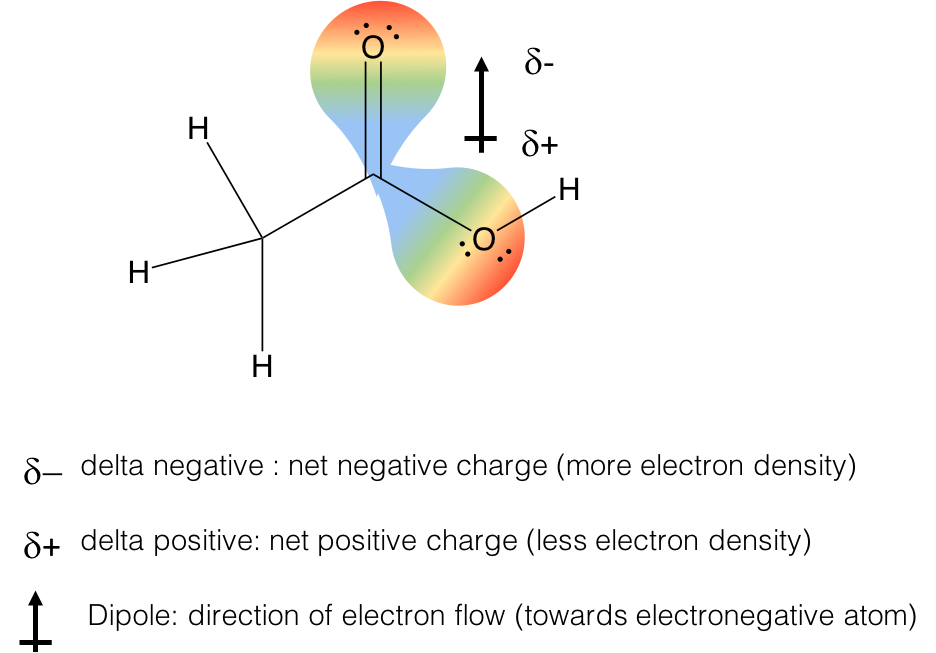
figure 1

Polar covalent bonds will interact with each other (red dipoles) in the “like-dissolves-like” concept you learned in organic chemistry.  The dipoles will interact with each other, the delta positive of one molecule will interact with the delta-negative of another molecule to create a dipole interation.
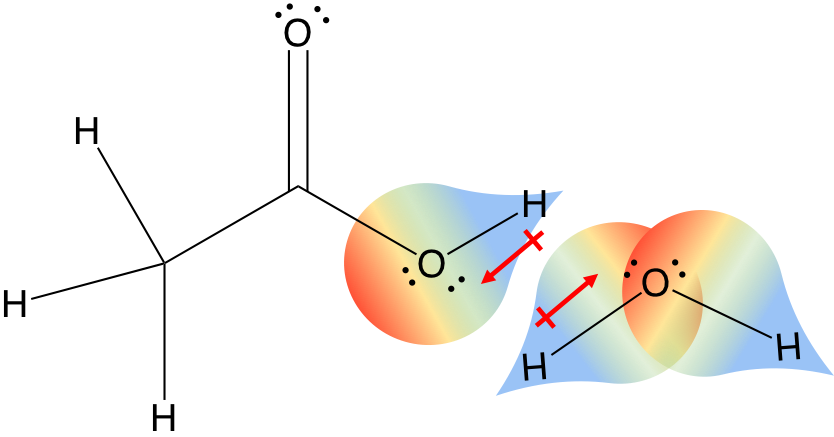
figure 2

  1. Hydrogen Bonds

When there is a hydrogen atom bonded to an element with lone pairs of electrons, it is possible for the delta positive hydrogen (the hydrogen bond donor) of one molecule to interact with the lone pair of electrons on another molecule (the hydrogen bond acceptor).

figure 2

This can happen for any molecules in solution, therefore protic solvents (such as ethanol) can form hydrogen bonds with itself while aprotic solvents (such as methylether) cannot. The result is easily seen in boiling point, which is 78C for ethanol but -23C for methylether.  One rule is that hydrogen bonds must be planar to the hydrogen donor an acceptor, so there are some constraints on structure.  This is what gives DNA its helical shape, which you will encounter in another course.

figure 5

  1. London-Dispersion Forces

These obscure forces are best described as very weak, very temporary dipole moments between non-polar covalent bonds.  Let’s look at butane, an alkane.  There is a temporary flow of electrons between each C-C bond and for an instant, a net dipole between each C-C bond.  This allows for temporary interaction with a neighbor molecule that has the opposite temporary dipole, and so on.  The effect is thousands of weak dipole interactions that add up to a large force, and the basis for what we refer to as hydrophobic interactions.
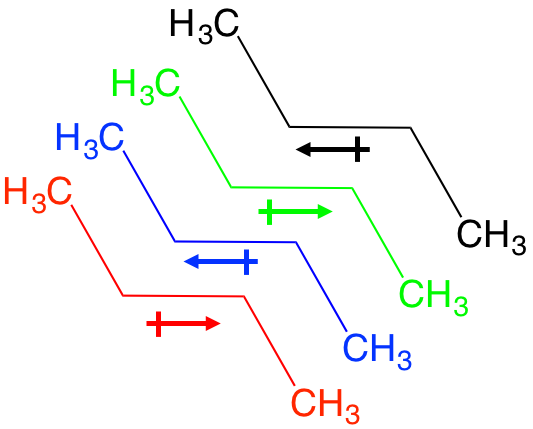
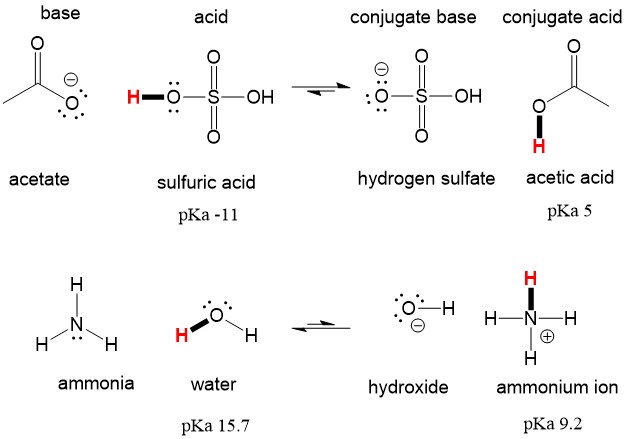
figure 4

Reviewing Acid Base Definitions

Posted on August 31st, 2016

Many students coming into organic chemistry have a difficult time with a concept that was covered extensively in general chemistry but often forgotten over the summer vacation.  This is the definitions of Acids and Bases.  It’s an important part of every mechanism in organic chemistry and your professor will likely assume you are an expert and jump right into the mechanisms whether you are ready or not!

We here at StudyOrgo have countless hours of combined experience tutoring students in just these situations to get you through the material and ready to ace the exam next month!  We have developed comprehensive explanations of the most common mechanisms, but have simplified their explanation in an easy to read format.  We also have developed a mobile app of our entire online content that members will be able to take advantage of while studying on the go!  Sign up with StudyOrgo today for help with Organic Chemistry this Fall Semester!

The classic definition of acids and bases are related to their ability to donate and accept protons into solution.  This is referred to as the Bronsted-Lowry Definition.  However, in organic chemistry, mechanisms are described by the flow of electrons.  Sometimes, an acids and bases can be thought of as their ability to donate and accept electrons.  Therefore, acids and bases were given definitions to reflect this feature.  This is referred to the Lewis Definition.

Type      Bronsted-Lowry Definition          Lewis Definition

Acid       Proton DONOR                                 Electron ACCEPTOR

Base      Proton ACCEPTOR                           Electron DONOR


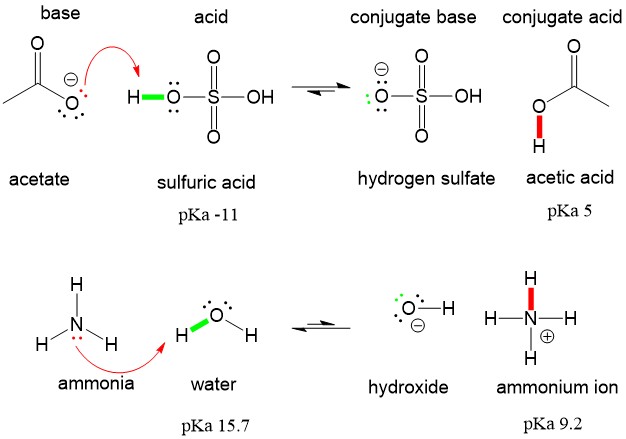
Let’s look at two examples, first using the Bronsted-Lowry Definition.  Reaction of sulfuric acid (H2SO4, the acid) and acetate ion (the base) to produces hydrogen sulfate (HSO4-, conjugate base) and acetic acid (H3O+, conjugate acid).  In this case, sulfuric acid (the acid) donates the red proton to acetate, which can accept the proton with a lone pair of electrons.  Reaction of ammonia (NH3, base) with water (acid) produces hydroxide (OH-, conjugate base) and ammonium ion (NH4+, conjugate acid). In this example, water (the acid) donates the red proton to ammonia, which accepts the proton with one if its lone pare of electrons.

acid base 1

Now let’s look at the same examples, but using the Lewis Definition.  In the sulfuric acid and acetate example, acetate (the base) donates the red pair of ELECTRONS to the red proton on sulfuric acid, which gives the electrons from the green O-H bond back to oxygen to produce the conjugate base, hydrogen sulfate. In the ammonia and water reaction, ammonia (the base) donates the red pair of ELECTRONS to the red proton on water, which gives the electrons from the green O-H bond back to oxygen to produce hydroxide.

Both descriptions produce the same reaction, but are THOUGHT about differently.  In organic chemistry, you will mostly think about DONATING ELECTRONS, because this is what drives a reaction mechanism.

acid base 2


We hope you have found these explanations useful and encourage you to sign up today for more clear-cut definitions of many organic chemistry concepts this semester!  Good luck!

Reviewing Molecular Orbitals

Posted on August 16th, 2016

Gearing up for Organic Chemistry this Fall semester is a smart and efficient way for reaching and maintaining a great grade in this class.  Most students find the pace of this class very accelerated compared to other courses.  This is because while there is a lot of information to learn, it also builds on previous concepts from general chemistry, a course most students want to forget!

But don’t worry!  StudyOrgo has you covered.  Our Editors have spent years tutoring and teaching Organic Chemistry to students and we have seen all of the pitfalls common to the first few weeks of the semester.  Our online platform allows members to learn organic chemistry concepts and mechanisms quickly and the material presented in an easy-to-follow format. Follow along with us and sign up with StudyOrgo today to help prepare you for all of your Organic Chemistry questions.

One of the concepts you will need to have mastered before you  begin the class is Hybridized Orbital Theory.

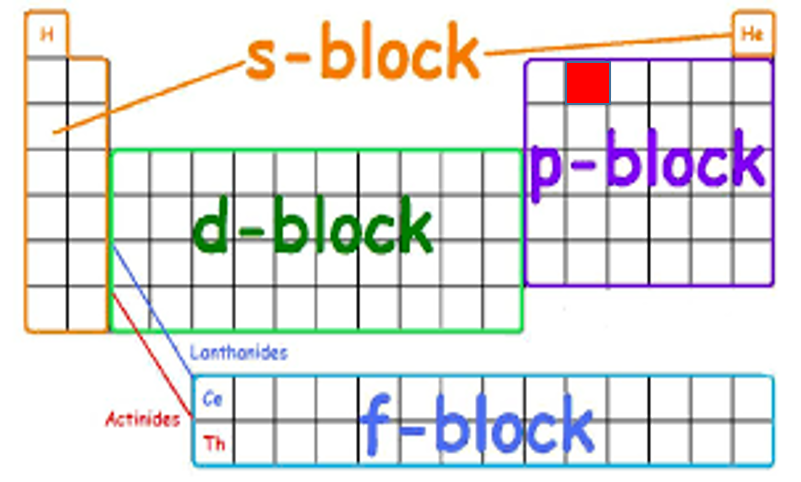
Lets look at carbon, the atom this class is about.  Recall that it has atomic number 6, which means it has 6 electrons.  Remember that the rows, or periods, of the periodic table reflect the outer electron orbital.  In the second period, carbon has 4 electrons in its outer orbital.  These are the electrons that are available for bonding.  The carbon atom wants to eventually achieve 8 electrons to fulfill the Octet Rule, so it needs to make 4 covalent bonds. Below is how the electrons are filled in their orbitals.  Recall that the columns, or groups, of the periodic table reflect the type of electron orbitals present in the atom.  The red block is the location of carbon, which indicates that carbon has 2 s-orbital and 2 p-orbital electrons.

AO fig 1

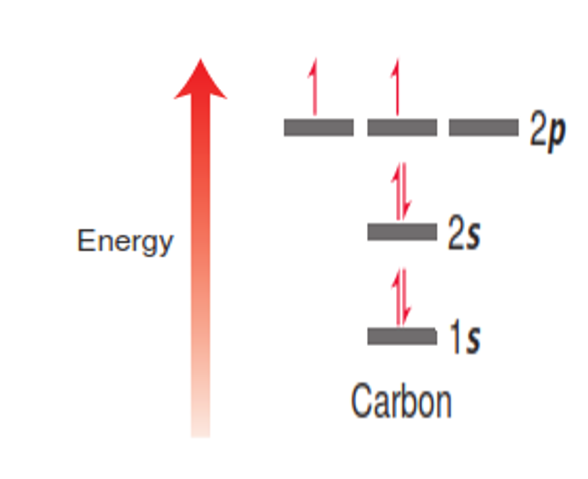
These electrons are arranged in an energy diagram according to their energy, shown below

AO fig 2

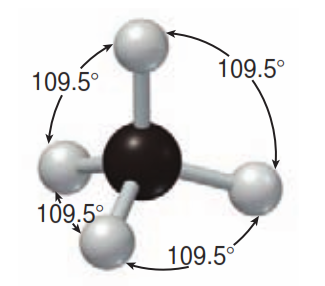
But it we consider the molecular shape of methane (CH4), we will observe it as tetrahedral, where all 4 C-H bonds appear to be equal, so how do the electron energies become equal?


Picture1

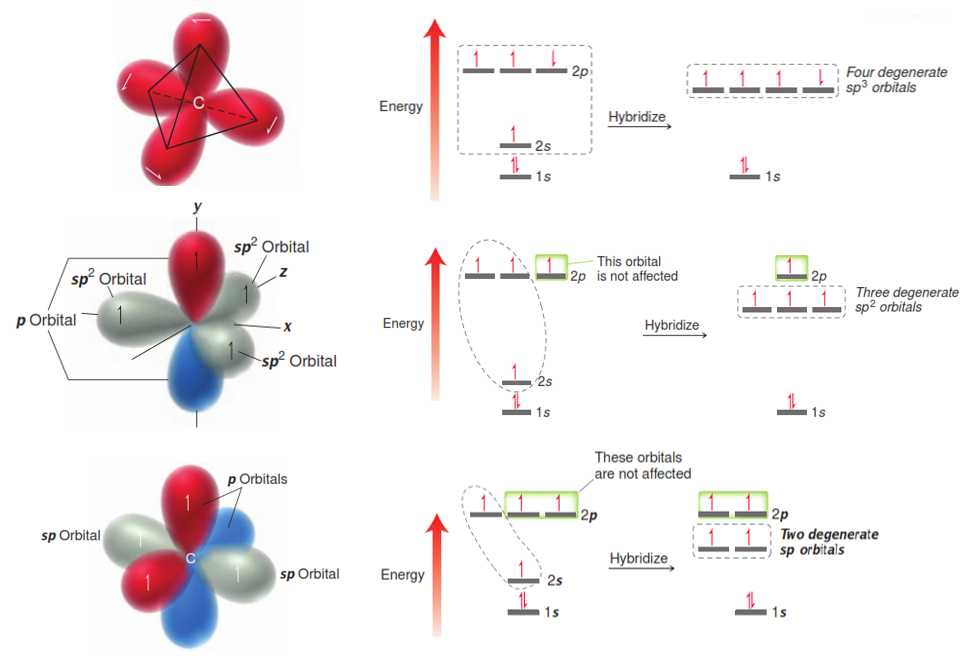
We explain this observation by assuming that the s-orbital and p-orbital electron energies, while different merge into an sp3 hybridized orbital.  In this model, the 2 s-orbial and 2 p-orbital electrons merge into something that resembles a dumbbell.  Since all of the orbitals have the same shape and energy, the C-H bonds of methane can be equal and form the observed tetrahedral orientation.  There are three types of hybridized orbitals for carbon;

AO fig 4

  • sp3 – which has 4 single (sigma) bonds. The molecular geometry is tetrahedral.
  • sp2 – which has 3 single (sigma) bonds and 1 double (1 pi) bond. The molecular geometry is trigonal planar.
  • sp – which has 2 single (sigma) bonds and 1 triple (2 pi) bonds. The molecular geometry is linear.

With a good study plan and help from StudyOrgo, you’ll have no trouble passing your organic chemistry quizzes and exams this semester.  Sign up today for more comprehensive and clear-cut explanations on all of your organic chemistry topics today!

What to Expect for Organic Chem Fall Semester

Posted on August 4th, 2016

This semester you will start Organic Chemistry and you have likely heard a lot of rumors about the class; statements from upperclassmen like “it’s difficult”, “this class is impossible” or “the professor is horrible!” We here at StudyOrgo have helped countless students overcome the difficulties of this class and can help you before you even enter the class. We have over 20 years of collective experience tutoring and teaching Organic Chemistry and have developed a few helpful tips that have saved students from the seemingly crushing pressure of Orgo 1.

Hard Organic Chemistry Professor

StudyOrgo has over 180 reaction mechanisms typically covered in Organic chemistry and explained in an intuitive and clear manner available in an online format. We also offer the Quiz Mode to allow you to customize reactions and test your memory of important parts of all of our reactions. We offer simplified and illustrated descriptions of complex concept topics that you will encounter in your first few weeks in Orgo 1. We also have developed a mobile app for iOS and Android smartphones that allows you to study organic chemistry on the go! Sign up with StudyOrgo today to take full advantage of our system!

Here’s what you can expect in the first few weeks of Organic Chemistry 1.

  1. Most professors will spend the first class reintroducing general chemistry topics, but he or she will completely assume you received an A+ in general chemistry and have a full grasp of all these concepts! Refresh your memory of atomic structure, valence electrons, acids/bases and pH/pKa concepts. These will be used right away in Orgo 1. If you aren’t sure, ASK FOR HELP!!

Tip #1 – Look at a syllabus – Remember, your syllabus is an official contract between you and the professor. Professors are required to disclose what you are required to learn and what grading rubric will be used. Professors can usually remove requirements (to the delight of the students!) but cannot easily add them. Use this to your advantage! Highlight the contents or reactions of the book that will be required and use this to focus your attention when studying this semester.

  1. Professors will almost always begin quizzing the second week, the midterm is only 7 weeks away. Prepare for them early!!

Tip #2 – Schedule you’re studying! – Now that you know where the book is and a rough idea of what you are responsible for learning from the syllabus, take a calendar and divide the time you have to each test by the number of chapters. Schedule 2-3 hours a week to study and DON’T SKIP OR RESCHEDULE. Use your Smartphone calendar to send you alerts and reminders for your studying appointment.

  1. The class is about to go supersonic speed! Stay ahead of the pace of the class to avoid falling behind!!!

Tip #3 – Read ahead – The first week of Orgo2, read two chapters to get yourself ahead of the class. Don’t try to understand everything, just read the text and try to understand the big ideas. This will completely change the way you pay attention in class and allow you to spend more attention and ask questions about the details in class instead of scrambling to write down notes and drawings.

Tip #4 – Attempt ALL homework problems – When tutoring students, they are often intimidated when we ask them to try sample problems. But after a few examples, every student does them better and better with each new problem. Some students have even made comments such as ‘why didn’t I do this sooner?’ We were at StudyOrgo agree! It takes a lot of time, but practicing the problems will make it easier for the quizzes and tests.

Most importantly, RELAX!! With a little time management and help from StudyOrgo, you will have no trouble getting an “A” in Organic Chemistry this year!

Summer Organic Chemistry Studying Tips

Posted on June 11th, 2016

Many students take Organic chemistry in the summer because the curriculum is cut in half.  You have only 8 weeks instead of 16 and the material is covered much more quickly.  This can be a great time-saver for your academic calendar, but it makes your studying twice as more challenging!  This class will be very fast paced, anywhere between 50-100 reactions will be presented, and the organized student will be the only one to get a great grade in the class. Fortunately, we here at StudyOrgo have developed simple, clear-cut explanations to help simplify your studying and maximize your time. Follow these tips for studying this semester and sign up with StudyOrgo today to help you get all of your reactions mechanisms and descriptions instantly!

  • Read ahead – You only have 8 weeks for this class, so staying up on the material is absolutely the most important thing to do!! Read two chapters this week to catch up and get yourself ahead of the class.  Don’t try to understand everything, just read the text and try to understand the big ideas. After you have read the chapter on the material for the next lecture, you’ll find it will completely change the way you pay attention in class.  You will pay more attention and come up with questions about the details of the material that are tricky, rather than scrambling to write down notes and drawings.


  • Attempt ALL homework problems – Students, who pay hundreds of dollars for a single tutoring session, are often intimidated when we ask them to try sample problems.  But after a few examples, every student does them better and better with each new problem.  Some students have even made comments such as ‘why didn’t I do this sooner?’  We couldn’t agree more!  Practicing the problems will make it easier for the quizzes and tests.  We have even developed a Quiz Mode that each student can customize to their studying needs.  Our presentation also allow for Flash Card mode, which allows you to quiz yourself as you study!


  • Read everything listed on the syllabus – Remember, your syllabus is an official contract between you and the professor. Professors are required to disclose what you are required to learn and how you will be graded. Professors usually remove requirements (to the delight of the students!) but cannot easily add them. Use this to your advantage! Highlight the contents or reactions of the book that will be required and use this to focus your attention when studying this semester.


  • Schedule your studying! –Another useful tip that past students have succeeded with is to take a calendar and divide the time you have until the next test by the number of chapters. Schedule 2-3 hours a week AT LEAST to study and DON’T SKIP OR RESCHEDULE. Use your iCal, Outlook or other smartphone calendar to send youself alerts and reminders for your studying appointment.


  • Sign up with StudyOrgo – The content of a StudyOrgo.com membership includes detailed mechanisms and description of over 175 reactions in the most crystal-clear and “get-to-the-point” format possible.  Many of our reaction have multiple examples, so you can learn and then quiz yourself in our website! For the student on-the-go, we have also developed a mobile app (iOS and Android) which provides all the functionality of the website! All of these benefits are included in your StudyOrgo membership!

With good time management and help from StudyOrgo, you WILL get a top grade in your summer Organic Chemistry course.  Sign up today!!